
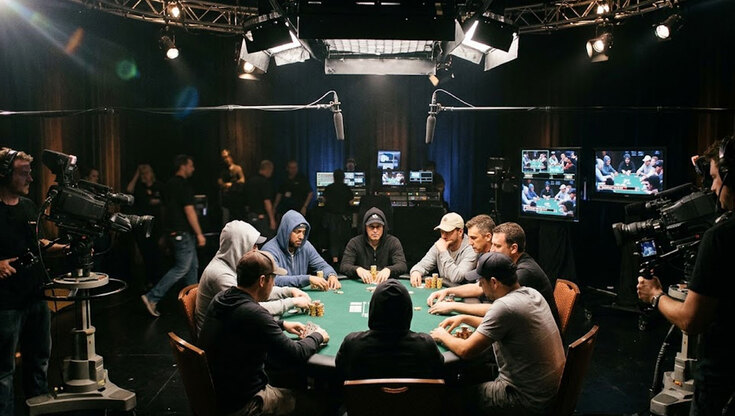
What should a poker fan watch once the famous films have been seen twice? The strongest answers are television series and documentaries, and a British late-night show from 1999 is the reason most viewers can now see players’ hidden cards.
Late Night Poker (1999)
In 1999, Channel 4 in the United Kingdom accepted a proposal for a tournament series from a production company based in Cardiff. The resulting show, Late Night Poker, used cameras built into the table that let viewers see each player’s hidden cards. That single change turned poker into something an audience could follow, since a viewer could now judge every bet against the cards behind it. The series is credited with helping to make poker popular in Britain during the 2000s.
The hole-card camera spread from this show to almost every poker broadcast that followed. Watching early episodes now is useful for that reason alone. The play is slower and the production is plain, but the basic format of televised poker, a view of the table and a view of each player’s cards, starts here.
High Stakes Poker (2006)
High Stakes Poker premiered on GSN on January 16, 2006, and it differed from almost every other poker show of the period because it filmed a cash game instead of a tournament. The minimum buy-in was $100,000, and the chips on the table represented real money. Players could bring cash to the table, and the blinds stayed constant across the session.
Gabe Kaplan and A. J. Benza hosted the early seasons, and Norm Macdonald took over as host for the seventh season in 2011. Daniel Negreanu reported that players in the first season were paid $1,250 an hour, and the 13 episodes of that season were edited down from about 24 hours of play. The series returned in December 2020 on a streaming service, with Kaplan and Benza back in the commentary booth.
The show is remembered for its pots. In the second season, Gus Hansen made 4 fives against Daniel Negreanu’s full house and won a pot of $575,700. Part of the fourth season raised the minimum buy-in to $500,000, and at one point more than $5 million was on the table at the same time. The largest pot in the show’s history, $1,227,900 between Guy Laliberté and David Benyamine, was never played out, because the 2 players agreed to reduce it to $238,900 after the cards were turned over. The show also brought the practice of running a hand more than once to a television audience. In a 2007 hand, Jamie Gold and Patrik Antonius agreed to deal the river 3 times on a $743,800 pot, and Gold won 2 of the 3 runs for $495,867.
Poker After Dark (2007)
NBC launched Poker After Dark in January 2007 and aired it 6 late nights a week. In its early seasons, 6 professionals each paid a $20,000 buy-in for a winner-take-all game worth $120,000, played out across 5 hour-long episodes in a single week. A 6th episode, called the director’s cut, replayed the week with commentary from the players. Because the game was winner-take-all, only 1 of the 6 players left each week with any money. The final episode of every week ended on a hand that decided all of it.
The commentary was deliberately sparse. Ali Nejad, the host, said little during hands and let the conversation at the table fill the time. The format showed poker at the pace it is played in a real game, with long stretches of folding and talk between the large pots. The show ended in 2011, during the industry turmoil that followed that year’s federal indictments.
All In: The Poker Movie (2012)
Douglas Tirola’s documentary examines why poker went through a revival in the United States in the 2000s, through interviews with professionals, amateurs, and writers. It premiered on the festival circuit in 2009 and reached a wider release in 2012. Slant Magazine gave it 3 stars out of 4 and described its subject as the growth and decline of poker as a middle-class preoccupation.
Other critics were less generous. Variety treated it as closer to a promotion for the game than a documentary, and the Los Angeles Times said it was for poker fans alone. IndieWire placed it among its top 10 indies to watch on video on demand that May and recommended it to fans of Rounders, the 1998 Matt Damon film. Its value is the range of interviews about the poker boom from people who were part of it.
Bet Raise Fold: The Story of Online Poker (2013)
Ryan Firpo’s documentary began production in late 2010 under the working title BOOM, as a film about the young professionals who had built careers by playing on the internet. It follows 3 of them, Danielle Andersen, Tony Dunst, and Martin Bradstreet, through the growth of online play and into its sudden collapse in the United States.
The collapse happened in the middle of filming. On April 15, 2011, federal prosecutors unsealed an indictment against the 3 largest online poker companies serving American players. After that Black Friday, their American business stopped almost overnight. The filmmakers had interviews from before and after that day, which gives the film a record of the same people at the height of their careers and at the moment their income disappeared. The finished film runs about 100 minutes, and the review site Film Pulse scored it 7 out of 10. Some reviewers noted that it leaves out the cheating scandals that had already damaged trust in the online game before 2011. The film stays with the players and leaves the companies in the background.
KidPoker (2015)
Gary Davis and Francine Watson directed this documentary about Daniel Negreanu, and it premiered on the Canadian sports channel TSN on December 1, 2015. It runs about 88 minutes. The film follows Negreanu from his childhood to the top of the professional game, but much of its attention goes to the people around him, including his brother Mike and his family.
Phil Ivey and Jennifer Harman, both of whom also played in the High Stakes Poker cash games, appear as interview subjects. The film fills in the personal history that years of broadcasts never covered, and it has been available on Netflix.
Viewing Order and a Final Figure
Watched in release order, these titles also show how much the economics of televised poker changed between 1999 and 2015. The figure that captures the high point is $1,250 an hour, the fee High Stakes Poker paid each player in 2006. The same players also had to put $100,000 or more on the table to sit down at all. The cash-game format is also why the pots from that show are still discussed, since every chip in them was the players’ own money.

Login to Geektown