
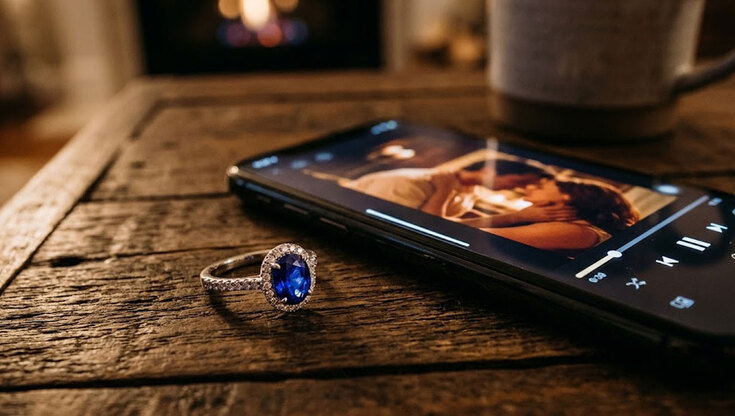
Rewatching a favourite film can turn into surprisingly specific research. One good close-up of a ring and you’re looking for a better angle, wondering whether you like the stone, the band or simply the whole scene.
It’s a perfectly reasonable starting point for an engagement ring. Even the One Ring, hardly a reassuring relationship symbol, can get you thinking about a design. The next step is working out which part you’d actually want to wear.
Borrow a detail you can describe
For a scene you can look up, try The Crown, Season 4, Episode 3, “Fairytale”, where Diana chooses her sapphire engagement ring. What would you borrow: the blue centre, the oval outline or the smaller diamonds around it? “I like the oval and the blue, but I’d like to see it without the surrounding diamonds” gives a jeweller much more to work with than “something like Diana’s”.
At Lily Arkwright, you can shop the ring range with that one detail in mind. Compare a plain band with diamond-set shoulders, the sections beside the centre setting. Do you want decoration around the stone, along the band, or neither?
Choose the stone for yourself
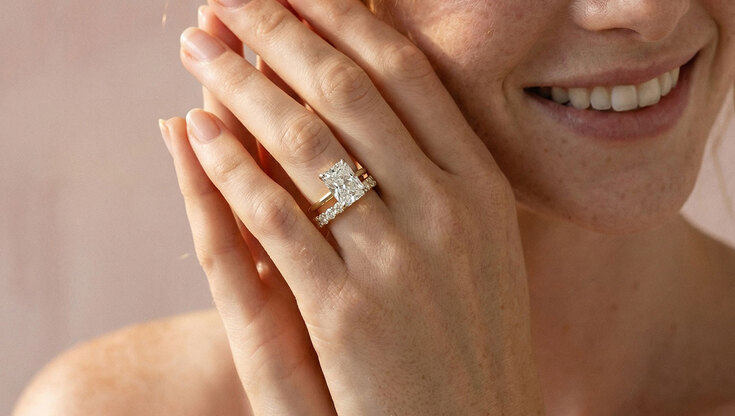
A round diamond solitaire such as Lottie, in the jeweller’s natural-diamond collection, puts a round natural centre in an 18ct white-gold four-claw setting. If you liked the simple top view in your reference, that is one real design to examine from the side as well.
For a longer outline, a lab-grown diamond in an oval cut is another possibility. Isabella, in the oval lab-diamond collection, has a plain 18ct yellow-gold band. These examples show two designs in different metals. To compare their outlines fairly, ask to try round and oval stones in the same metal and similar settings.
A screenshot cannot establish diamond origin, so check the documentation for the stone you’re offered.
Look at what the close-up leaves out
A screenshot is good for showing a particular angle. It gives you much less help with the underside of the setting, the width of the band against your palm or how the ring feels between your fingers. Ask for those views of the real designs you’re considering.
Lottie is a useful illustration: its four-claw head has a tulip-like profile, while the band has no additional stones. Someone drawn to a plain overhead view might enjoy that little piece of metalwork beneath it. Someone else might want a plainer head too. The side photograph helps you explain the difference.
Put the ring on the finger you intend to use. Rest your hand on the counter and move your fingers as you would when typing. Notice whether anything presses or feels awkward. A ring that looks right for a character may need a different height or band width to suit you.
Check the size away from the screen
Look for the centre stone’s length and width in millimetres. GIA’s carat-weight guidance makes the distinction clear: carat measures weight, so it does not give you the complete picture of a diamond’s visible size.
For an oval, compare a fuller outline with a longer, narrower one. Ask for the actual measurements of the stones you could order; a carat selection alone doesn’t fix those dimensions. Include any visible claws or surrounding stones when judging the width of the finished setting.
Check which stone size each product photograph or video shows. Isabella’s listing identifies its studio photographs as 2ct, while the model image and video show 4ct. Saving a picture without that detail can leave you asking to try a different size from the one you thought you’d chosen.
Let the wearer edit the idea
If you’re choosing for a partner, show them the reference before treating it as a shopping instruction. Loving a character, admiring their wardrobe and wanting their ring are three different reactions. A quick “Is it the shape you like, or the whole look?” can prevent a very confident wrong turn.
Leave room for the answer to change at a fitting. They might love the oval but prefer white metal, or want to remove the decoration that first caught your eye. Keep the detail they enjoy and ask for a complete quote for that version. The film doesn’t set the spending limit.
Keep the story that made you notice
There may be a reason that particular film or series matters: a first cinema trip together, a shared obsession or the programme you kept discussing long after the finale. Put that connection in the card or the words you plan to say. The ring can carry the reference quietly.
Bring the screenshot to the appointment, along with a short note: “I like the plain band and the longer centre. I want to compare the setting height.” You’ve given the jeweller a starting point and yourself room to find something you love. The next rewatch will still mean something, even if your ring has become its own design.

Login to Geektown