
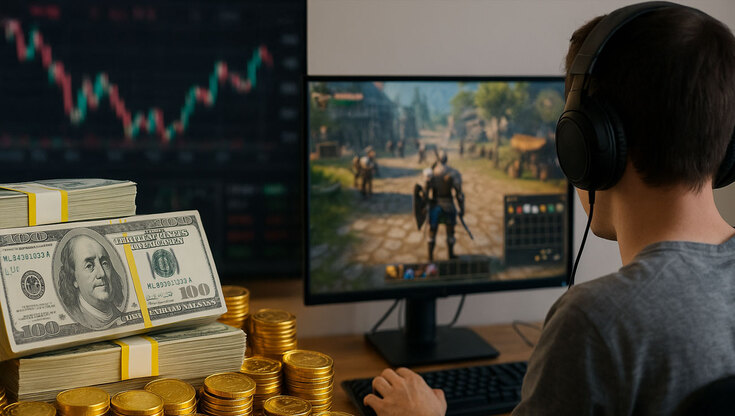
Though completely virtual, player-driven video game economies are a simulacrum of our current economy, driven by supply and demand. In an environment where resources are theoretically infinite, MMO game developers find ways to prevent factors like inflation and scarcity. In some cases, players can even make real cash through these virtual economies by providing specific services that are in demand in MMOs.
How MMOs Are Modeled After Real Economies
MMOs are social experiences by design, as their main appeal is creating dynamic and meaningful interactions with others that cannot be simulated in single-player games. One of the more significant social aspects of an MMO is its market economy since these are usually player driven. Unlike single-player games, where markets are controlled, static, and rigid, MMOs simulate market trading forces like scarcity, inflation, and supply and demand through player interaction.
MMOs are designed to keep people playing the game by providing an appealing core experience, such as combat in dungeons and raids, while incentivizing the accumulation of currency and participating in gathering and crafting “life skills.” These “life skills” feed into the core gameplay loop by creating better in-game weapons, armor, and consumables using raw materials extracted in the game world. To progress in the game, players must obtain better items sourced through crafting with better materials or killing hostile NPCs until they reward said items.
Rare, powerful items and items earned through achievements are the main hedonic goal for most MMO players, as these provide tangible gameplay results and grant the player a higher place in the social strata. The difficulty of obtaining these items is what creates demand within that economy.
The need for powerful items and character progression creates a demand that players can either work towards or purchase with the game’s virtual currency. To create a supply for items, MMOs usually impose a chance system where certain in-game items and resources are only rewarded after repeated gameplay. Since MMO items “respawn,” item rarity and drop chances are a necessity to maintain scarcity.
Converting Virtual Currency to Cash
Virtual currencies are printed by players, which makes inflation inevitable as players run out of items to spend on. However, developers have devised ways to keep inflation in check. One of these is currency sinks that are used for purchasing services such as fast traveling, gear repairs, character upgrades, and expensive mounts.
Another way for virtual currencies to remain valuable is by assigning them to a service with a set cash value. For example, World of Warcraft (WoW) uses a supplementary subscription service called WoW Tokens that cost $20, where players can use in-game gold to get a 30-day subscription. Currencies in MMOs like WoW accumulate slowly through gameplay or trading and are time-gated to prevent rapid inflation. This spurs players who cannot meet the labor cost or time investment to buy WoW gold on marketplaces like PlayerAuctions as an alternative to manually accumulating currency through gameplay. This sets the precedent for a real-money trading economy in an MMO.
Non-MMO Economies And Real Money Trading
MMOs are the definitive standard for RMT, but other game genres also provide a viable platform for paid in-game services. Competitive online games have a thriving RMT market despite lacking a dedicated economic system, such as auction houses, player-to-player trading, and item trading. RMT sellers use e-sports as a platform, like League of Legends, Overwatch, DotA 2, Valorant, and the R6 marketplace to sell either rank boosting services or accounts with varying ranks.
What both MMOs and e-sports games have in common is scarcity. The former have rare items that grant more player power, and the latter have ranks that require high mechanical and strategic skill to reach. While one is more intangible than the other, competitive games have created a demand for in-game ranks with a variable supply, especially for ranks with a Top 500 or Top 100 leaderboard that are limited. The demand for prestige in a competitive game invariably creates a hidden market where players exchange cash for a service that helps them receive that prestige.
Summary
The prospect of generating extra income through playing video games, plus the artificial scarcity and restrictions placed on MMO and e-sports game progression by developers, naturally form economies of virtual goods and services that are exchanged for real-life currencies. While both can be reasonably achieved through gameplay alone, the effort required may be too difficult for some players, which creates a demand for paid services to alleviate the time and skill requirements.

Login to Geektown