
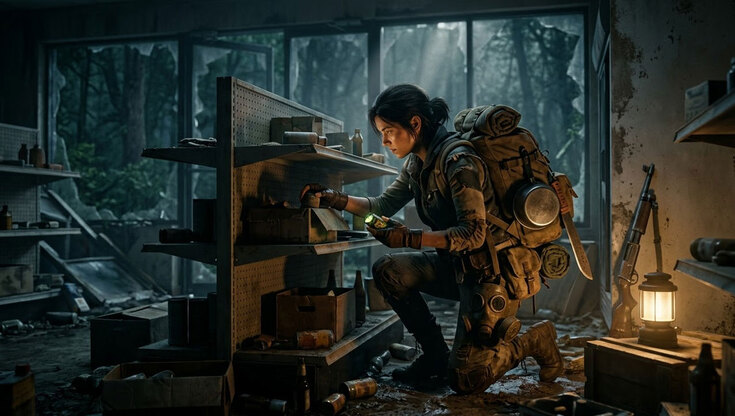
There’s a very specific lie Fallout 76 players tell themselves. “I’ll just jump on for twenty minutes.”
What that really means is that you’ll be spending your evening wandering the Appalachians, opening every container, looting every enemy you kill, and slowly coming to the realization that while you didn’t plan on carrying that bow knife or that knife or that machete or the axe on the back of your bow, you probably do need it.
That’s the odd brilliance of Fallout 76. For all the changes it has gone through since launch, one of its strongest hooks is still the simplest one: the constant feeling that the next place you explore might have something worth finding. Not remarkable or unusual in the slightest. Not even necessarily the slightest bit clever. Just interesting enough to keep you up.
And somehow, that still works.
It’s Chasing Possibility, Not Just Loot
A lot of loot-heavy games are built around efficiency. You know what item you want, where it drops, and roughly how long the grind will take before it starts feeling suspiciously like admin. Fallout 76 is much messier than that, and that’s part of the appeal.
You’re often not chasing one exact reward so much as chasing the possibility that the next legendary enemy, hidden stash or forgotten building might drop something unexpectedly useful. Or weird. Or weirdly useful, which is arguably the game’s preferred setting.
That unpredictability gives the loot loop more personality than a straightforward farm. Even routine sessions can go off in strange directions. You head out for materials, get distracted by an event, poke around a location you had no real intention of visiting, and return to camp with far more gear than you planned and only a vague memory of how you got there.
It is not tidy. It is, however, very effective.
Appalachia Is Built to Ruin Your Plans
The map does a lot of work here. Appalachia is full of places that practically dare you to take a detour. A half-collapsed house on a ridge. A suspicious shed in the woods. A building that looks like it contains either treasure, disaster, or a deeply unnecessary amount of scrap.
Usually all three.
That’s why I find myself loot hunting in Fallout 76 more so than actual structuring of the gameplay systems around dropping resources. It’s less a system and more a behavior, shaped by what tends to be the most rewarding choice rather than what is the most fair. The world frequently rewards inquiring, and it can take only a handful of times for the pattern to be deeply embedded to the point that the logic for hunting even seemingly unlikely places feels more than justified—even when a decent amount of life experience would strongly contradict it.
And then the game teaches you to think that way. And then you can’t stop thinking that way. You stop looting because it’s part of the mission, and then you just start looting because, “There might be something in here.”
In Fallout 76, “might” is often all it takes.
The Good Stuff Feels Personal
Part of what keeps the whole loop engaging is that loot in Fallout 76 rarely feels like progression in the blandest sense. The right item does more than improve a number. It sharpens a build, supports a playstyle, or nudges you towards a slightly different way of playing.
That makes good drops feel personal.
It also helps explain why players stay invested in hunting for very specific gear and why there’s still broader interest around certain Fallout 76 items. People are not only looking for stronger equipment; they’re looking for pieces that fit the character they’ve been shaping over time.
That sense of fit matters. When an item feels like it belongs in your build, it tends to be far more memorable than something that is merely useful.
The Best Sessions Are Usually Accidental
Perhaps the funniest thing about Fallout 76 loot hunting is that the most satisfying sessions often begin with no real plan at all.
You managed to get off track, got caught up in an event, and for some reason felt the need to visit the convenience store, and now after an hour of struggling to carry all of your items back while managing to keep all of your limbs accounted for, you are left with aching legs, a full inventory, a healthy dose of frustration at the ridiculous amount of items you’ve acquired, and a sense of pride at just how much you’re able to carry around.
That’s the loop. Not efficient farming, by a long shot, but an endless parade of excuses, surprises, follies and dumb luck that all work their way into a true tale.
And years later, that’s still why I think loot hunting in Fallout 76 is weirdly addictive. It’s not because every single drop is valuable. Rather, it’s the notion that the next drop could be. Fallout 76 still finds itself balancing quality of life with uncertainty – giving you just enough to keep you invested.
That feeling is simple, slightly irrational, and very hard to shake.

Login to Geektown