
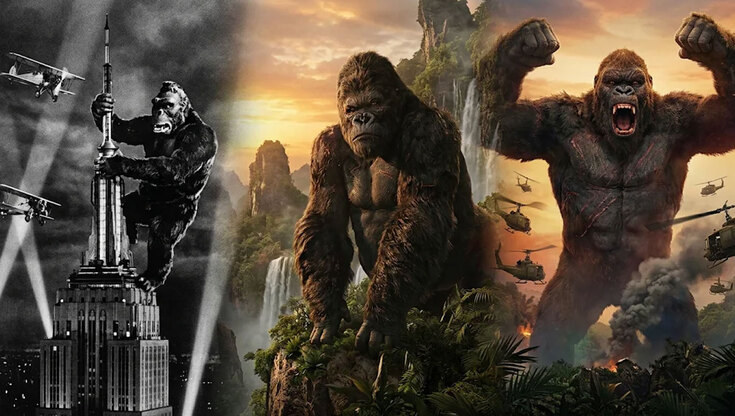
Few film characters have lasted as long as King Kong, and fewer still have changed so much along the way. In a little over ninety years he has been an 18-inch puppet, a man in a suit, a 40-foot machine that barely worked, a motion-capture performance and a fully digital giant who shares a universe with Godzilla. Each version says a good deal about the effects technology of its day. Here is how the great ape got from Skull Island in 1933 to the MonsterVerse.
1933: The Eighth Wonder of the World
The original King Kong was made by RKO Radio Pictures and directed by Merian C. Cooper and Ernest B. Schoedsack. It opened in New York on 2 March 1933, playing at Radio City Music Hall and the RKO Roxy, with Fay Wray as Ann Darrow, Robert Armstrong as the showman Carl Denham and Bruce Cabot as Jack Driscoll.
The star, of course, was animated by hand. Willis O’Brien and his team brought Kong to life with stop-motion, moving jointed models that stood only around 14 to 18 inches tall, one frame at a time. Max Steiner’s score did much of the emotional work, and the closing scene on the Empire State Building, with biplanes circling the ape, became one of the most recognisable images in cinema. Denham’s final line, “It was Beauty killed the Beast”, has been quoted ever since.
RKO moved quickly: a sequel, Son of Kong, reached cinemas before the end of 1933. The original’s reputation has only grown, and in 1991 it was added to the United States National Film Registry.
Suits and machines: Toho and the 1976 remake
Kong’s next major appearances came from Japan. Toho, the studio behind Godzilla, licensed the character for King Kong vs. Godzilla in 1962, directed by Ishiro Honda. Stop-motion gave way to a performer in a suit, and the film set up a rivalry that Hollywood would return to nearly sixty years later. Toho followed it with King Kong Escapes in 1967.
The American remake arrived in December 1976, produced by Dino De Laurentiis, directed by John Guillermin and released by Paramount. It moved the story to the present day, cast Jeff Bridges, Charles Grodin and Jessica Lange, and swapped the Empire State Building for the twin towers of the World Trade Center.
The production is remembered as much for its effects troubles as for its story. Carlo Rambaldi built a 40-foot mechanical Kong that was meant to carry the film, but it appears on screen for only a few seconds. For most scenes Kong was a performer in an ape suit, chiefly the make-up artist Rick Baker, who went uncredited. Even so, the film received a Special Achievement Academy Award for its visual effects, shared with Logan’s Run. A sequel, King Kong Lives, followed in 1986.
The skyscraper image has travelled well beyond cinema, too. Blueprint Gaming’s King Kong Cash slot, a jungle-themed game of chance with no connection to any of the films, has Kong asleep beside the reels and sets one of its bonus rounds on the Empire State Building. When a single silhouette can be borrowed that freely, it has plainly become part of the common language of popular culture.
2005: Peter Jackson goes back to 1933
Peter Jackson had wanted to remake King Kong for years, and after The Lord of the Rings he got his chance. His 2005 film for Universal returned the story to 1933, with Naomi Watts as Ann Darrow, Jack Black as Carl Denham and Adrien Brody as Jack Driscoll.
This time Kong was a digital character built by Weta Digital around a motion-capture performance from Andy Serkis. The result was a Kong with an inner life: weary, scarred and capable of something close to tenderness. The film won three Academy Awards, for visual effects, sound mixing and sound editing.
The MonsterVerse: Kong as a hero
The current era began with Kong: Skull Island in 2017, directed by Jordan Vogt-Roberts for Legendary Pictures and Warner Bros. The second film in the MonsterVerse, it is set in 1973, stars Tom Hiddleston, Samuel L. Jackson and Brie Larson and keeps almost all of its action on the island. Terry Notary performed Kong through motion capture.
Adam Wingard’s Godzilla vs. Kong followed in 2021, restaging the 1962 match on a far larger scale, and Wingard returned for Godzilla x Kong: The New Empire in 2024. The next chapter, Godzilla x Kong: Supernova, is directed by Grant Sputore and scheduled for release on 26 March 2027.
What stands out across the decades is how the character has shifted. The 1933 Kong was a terror with a tragic end. Today’s Kong is closer to a weary guardian, and audiences are firmly on his side. The technology keeps changing, but the appeal of a giant ape with a recognisable heart has not.
18+ only. Treat any game as paid entertainment, never a way to make money. Free, confidential help 24/7: National Gambling Helpline, 0808 8020 133.

Login to Geektown