
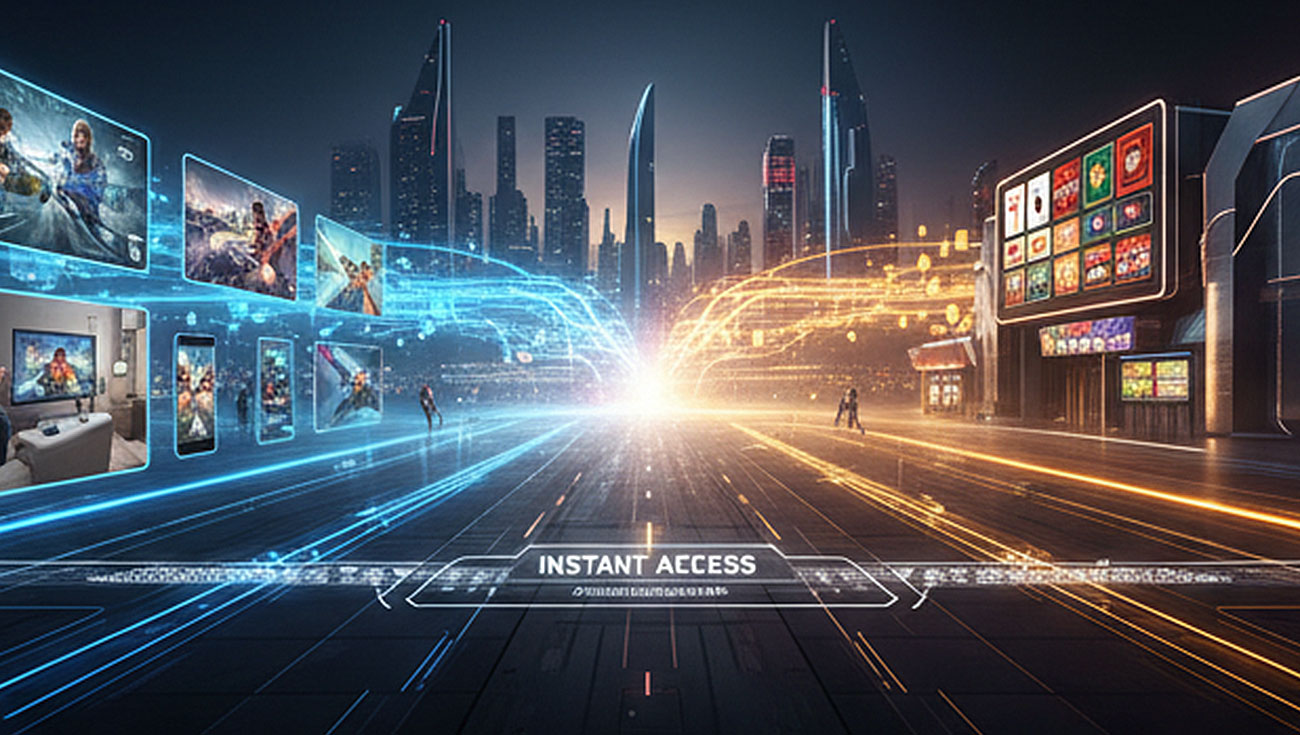
It is assessed that as we speak, there are 5.56 billion people, nearly 68 per cent of the world’s population, who use the internet, consume digital media, and expect entertainment the moment they want it. That demand for immediacy stretches through every aspect of online life and dictates how platforms deliver films, music, and even everyday recipes.
Gaming applies the same logic, with cloud services removing the need for high-end hardware. Other industries follow, and gambling has also leaned into the same instant-entry appeal — though in very different ways depending on the market. The conclusion is clear: instant access has become the standard against which digital entertainment is measured in the twenty-first century.
Streaming as Standard
In line with the global “low friction” approach in technology development, bulky downloads and expensive consoles almost feel as old as dinosaurs, completely outlived by cloud services in gaming. Players can open a blockbuster release on a mobile, a tablet, or even a smart TV without needing the hardware once thought essential. This flexibility has made cloud-based play attractive to a wide base, from those with older laptops to those who simply want to pick up and continue a game wherever they are.
This instant attraction caused services like Xbox Cloud Gaming and Boosteroid to flourish since they completely erased burdensome hardware limits. The scale of their growth is clear when looking at the cloud gaming market size, which Fortune Business Insights values at USD 9.71 billion in 2024. With forecasts climbing beyond USD 120 billion, the numbers suggest that cloud delivery is not just replacing old methods but rewriting the rules of how the games industry grows.
Casinos Without Barriers
The same pattern is visible in gambling platforms, where speed and privacy often compete with game variety or bonus levels as the key selling points. Some operators, usually licensed outside the UK, market themselves as no-verification casinos, sites that claim to cut out lengthy sign-ups and ID uploads, replacing them with near-instant access that mirrors the simplicity of joining a streaming service.
It’s important to note that casinos legally licensed in the UK by the Gambling Commission must verify a player’s age and identity. That process is non-negotiable for consumer protection. The “no KYC” model is generally tied to overseas platforms that can still market to UK players but operate under very different rules.
The appeal of these offshore sites lies in the promise of minimal personal disclosure and faster onboarding, which can be attractive to those prioritising privacy and convenience. In the context of gaming culture, this is another iteration of a broader expectation: the less resistance between desire and play, the better.
Behind the Demand for Frictionless Play
Frictionless entertainment is now a constant, but the roots of this lie in how audiences have been defined by streaming. Growing up with the ability to press play at any moment created an expectation that choice should be instant in every area of life. Entertainment, communication, and leisure are all viewed through this lens, so waiting feels less like a pause and more like an unnecessary obstacle. Platforms that demand too many steps quickly lose users to rivals that provide immediate entry.
Research supports this transition, showing that people consistently gravitate toward formats that maximise agency and immediacy. This is why a great majority of content consumers prefer streaming platforms over television, and the same psychological drive leads players to cloud gaming and certain casino platforms overseas. Both thrive because they provide autonomy where traditional systems imposed delay.
Technology Driving Instant Access
Behind all these experiences sits a backbone of infrastructure that has advanced rapidly in the past decade. Cloud servers host demanding games and push them to lightweight devices with minimal latency. Payment solutions now process deposits and withdrawals in seconds, with crypto and e-wallets complementing traditional cards. Mobile networks, especially 5G, have removed many of the barriers that once made high-data services unreliable on the move.
Together, these technologies explain why instant access is no longer a promise but an expectation. Players can move seamlessly from one device to another, pay instantly, and enter without friction. The combined effect is a unified environment where access feels fluid, and delays are increasingly rare.
What Comes Next
Looking forward, the logic of instant access is unlikely to slow. The same players who enjoy cloud gaming may soon see casino-style mechanics folded into mainstream titles, while casino platforms may integrate more features from video games to maintain engagement. Both sides are moving toward experiences designed around speed, privacy, and continuity.
Forecasts and adoption rates point in the same direction: platforms that remove barriers are setting the course for gaming and gambling alike. What comes next is less about proving the demand for instant access and more about how far technology can stretch that promise.

Login to Geektown