
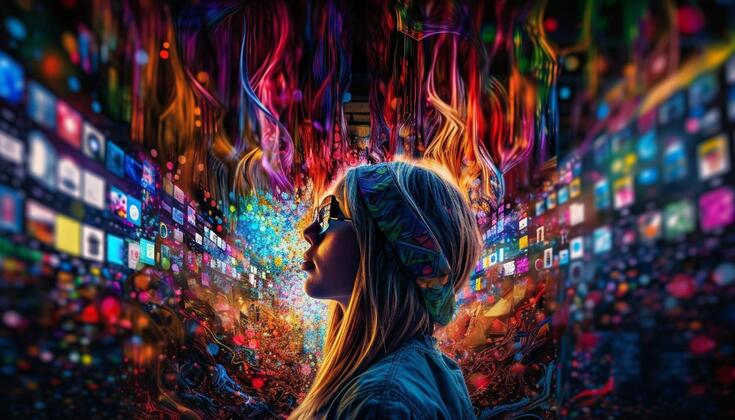
Image by vecstock on Magnific
Fandom has always been visual. From hand-drawn fan art traded at conventions to elaborate cosplay and meme edits, fans have never just consumed their favourite stories, they’ve remixed and reimagined them. Now generative AI has handed those communities a powerful new set of tools, and the results are reshaping how fandoms create, share, and argue about visual culture. Here are eight of the biggest shifts happening right now.
1. Fan Art Has a New (and Controversial) Collaborator
The most obvious impact is on fan art itself. Where once a striking piece required years of drawing practice, anyone can now describe a scene and watch it materialise. This has democratised creation, letting fans who can’t draw finally visualise the crossovers and “what if” scenarios living in their heads.
It’s also deeply divisive. Many traditional artists feel threatened by tools trained on existing art, and the debate over what counts as “real” fan art has split communities. The technology hasn’t replaced human artists, but it has forced fandoms to wrestle with hard questions about skill, originality, and credit.
2. Hyper-Specific Memes at Unprecedented Speed
Meme culture thrives on speed and specificity, and AI image tools are rocket fuel for both. Fans can now generate a perfectly tailored visual gag, a beloved character in an absurd situation, in seconds, rather than hunting for the right screenshot to edit.
This has accelerated the meme lifecycle dramatically. A new episode airs, and within minutes the fandom has produced a flood of bespoke, AI-assisted reaction images that would have taken hours to make by hand.
3. Reviving and Reimagining Beloved Characters
Generative AI lets fans visualise things official creators never will: a cancelled show’s “lost” seasons, an actor’s character aged up decades, or a beloved franchise reimagined in a completely different art style. These speculative visuals scratch an itch that canon often leaves unsatisfied.
For long-dormant fandoms, this can breathe new life into a community, giving people fresh material to react to and discuss even when no official content is being produced.
4. The Rise of Multi-Model Experimentation
As the tools mature, fans are realising that no single AI model does everything well. One excels at photorealism, another at stylised illustration, a third at faithful prompt-following. This has pushed creators toward platforms that bundle several engines together.
An AI Image generator like Adobe Firefly has leaned into exactly this, acting as a multi-model hub where users can access Adobe’s own models alongside partner models such as Google’s Imagen and Gemini, OpenAI’s GPT Image, and Black Forest Labs’ FLUX, all through a single login. For fans, the appeal is being able to run the same prompt through different models and compare results side by side, choosing whichever best captures the character or mood they’re after. It turns image creation into a kind of creative experiment rather than a one-shot gamble, and it’s changing how seriously hobbyist creators approach their craft.
5. Provenance and the Fight Over “Is This AI?”
As AI images flood timelines, fandoms have become obsessed with a new question: was this actually made by a human? Accusations fly, and artists increasingly feel pressure to prove their work is hand-made.
This is where provenance tools matter. Firefly, for instance, attaches Content Credentials, essentially a tamper-evident “nutrition label”, to generated images, recording how they were made. As these standards spread, they could help communities have more honest conversations about what they’re actually looking at, rather than relying on guesswork and pixel-peeping.
6. Cosplay Planning and Concept Visualisation
Before spending hundreds of pounds and weeks of effort on a costume, cosplayers are now using AI to previsualise their builds. They can see how a colour palette reads, test a design concept, or imagine themselves in a getup before committing a single stitch.
According to The Verge, generative tools have rapidly moved from novelty to everyday utility for creative hobbyists, and cosplay is a textbook example, AI as a planning sketchpad that lowers the risk of an expensive creative gamble.
7. New Tensions Around Consent and Likeness
Not every development is celebratory. The same tools that let fans honour actors and characters can also generate unwanted or inappropriate images of real people. Fandoms are grappling with thorny ethical lines around deepfakes, RPF (real person fiction) imagery, and the consent of the performers they admire.
Many communities have responded by drafting their own norms and rules, an evolving form of self-governance as the technology outpaces formal regulation.
8. A Blurring Line Between Fan and Creator
Finally, AI is eroding the old boundary between professional creators and the fans who love their work. Studios increasingly notice fan-made AI concepts; some fan creators build genuine followings rivalling official channels. The flow of influence now runs both ways.
This blurring is perhaps the most profound shift of all. Fandom was always a conversation with the source material, but generative AI has turned up the volume, giving fans tools powerful enough to shape the visual culture of a franchise rather than merely respond to it.
The Bigger Picture
Generative AI hasn’t replaced the heart of fandom, the love, the obsession, the community. What it’s done is hand fans an extraordinarily powerful brush and let them loose. The result is messier, faster, more contentious, and more creative than ever. Like every tool before it, its real meaning will come from what these passionate communities choose to make with it.

Login to Geektown