
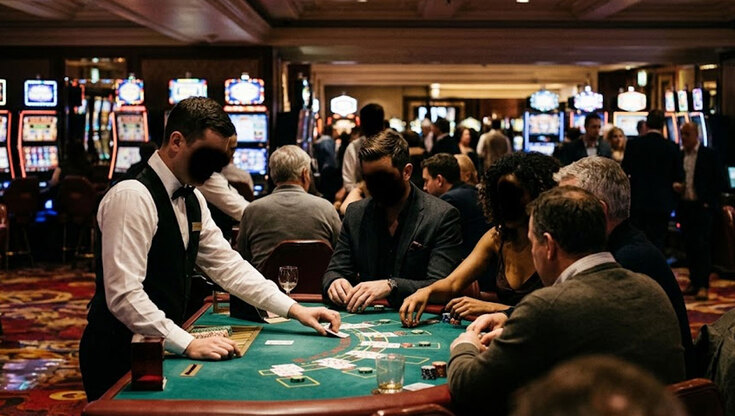
Few settings give filmmakers such a concentrated mixture of glamour, suspense and human vulnerability as a casino. When you watch a memorable gambling scene, you can usually understand the stakes within seconds because the setting communicates wealth, risk and temptation almost instantly.
The lights create visual drama, the tables provide natural stages and every decision carries a sense of consequence, and that combination has made casinos remarkably useful across decades of cinema and television. From elegant card rooms to crowded Las Vegas floors, you can see the same setting represent ambition, romance, deception, danger or simple curiosity.
The appeal becomes even stronger when you consider how efficiently gambling creates tension. A single card, roll or spin can alter someone’s fortunes within moments, so filmmakers can build suspense without lengthy explanations. The best casino movies understand this instinctively because they use games as extensions of character.
When you watch someone place a final bet or quietly study an opponent, you are watching personality become action. Confidence, fear, greed, calculation and desperation all become visible through small gestures. That is why the strongest scenes remain compelling even if you have little interest in gambling itself, as the human drama always sits at the centre.
Casino Royale turns poker into psychological warfare
If you want to see how a gambling scene can become a genuine battle of personalities, Casino Royale provides an excellent starting point. Released in 2006, Daniel Craig’s first Bond film puts James Bond against Le Chiffre in a high-stakes Texas hold’em tournament.
The story sends Bond to Montenegro after Le Chiffre organises the game to recover money he has lost, so the poker table becomes a crucial part of the wider espionage plot. Vesper Lynd also joins Bond at the table as the Treasury representative responsible for the government funds. You therefore get financial pressure, romantic tension and international intrigue operating through the same game.
The best casino movies recognise that silence can create more suspense than explosions and Casino Royale uses that principle exceptionally well. Bond studies Le Chiffre’s behaviour, watches the other players and repeatedly has to recover after suffering serious setbacks. You can almost feel the tension increasing whenever the camera returns to the players’ faces because every expression carries information.
The production team also faced the considerable challenge of filming a complex ten-player Texas hold’em game, with director Martin Campbell later describing the sequence as one of the most difficult scenes he had filmed. The result feels like a duel without conventional weapons.
Ocean’s Eleven makes the casino a playground
Steven Soderbergh’s Ocean’s Eleven gives you an entirely different perspective on casino culture because the gambling floor becomes part of an elaborate robbery. Released in 2001, the film follows Danny Ocean and his carefully assembled team as they attempt to steal money from the Bellagio, MGM Grand and The Mirage.
The Bellagio serves as the centrepiece of the operation, so its famous casino floor becomes a visual playground for the characters. You watch the team study routines, exploit weaknesses and coordinate their movements, making the resort feel almost like a gigantic puzzle waiting to be solved.
That approach helps explain why Ocean’s Eleven remains one of the best casino movies for viewers who enjoy strategy, style and character chemistry. The famous vault sequence gives the crew a clear objective, yet the entertainment comes from watching each specialist perform a specific task.
You can follow the operation almost like a game yourself because Soderbergh gives you enough information to appreciate the risks without revealing every secret immediately. Nevada’s film authorities also continue to recognise Ocean’s Eleven as one of the state’s iconic productions. That connection matters because the film uses Las Vegas as a character with its own rhythms, rules and visual identity.
Casino brings the darker side of Las Vegas
Martin Scorsese’s Casino takes you much deeper into the darker side of gambling culture because its glittering surfaces conceal a brutal struggle for control. Released in 1995, the film stars Robert De Niro, Sharon Stone and Joe Pesci as Sam ‘Ace’ Rothstein, Ginger McKenna and Nicky Santoro.
Scorsese uses the final years of organised crime’s influence over Las Vegas as the foundation for a sprawling story about money, power, marriage and loyalty. When you watch the casino floor through Ace’s eyes, every flashing light and carefully controlled table becomes part of a vast system that depends on discipline.
Among the best casino movies, Casino stands apart because it spends so much time examining what happens behind the glamour. You see surveillance, money management, cheating, intimidation and personal conflict operating alongside the games, where the casino gradually feels more like a machine driven by competing ambitions.
The BFI describes the film as a portrait of the tail end of the American mob’s reign over Las Vegas, while its visual style captures the intoxicating effect of power and money. If you revisit the film today, you can still appreciate how Scorsese turns wealth and excess into sources of unease.
Rain Man makes blackjack part of the story
Rain Man shows you how a casino scene can become unforgettable without making gambling the entire subject of the film. Released in 1988, the drama follows Charlie Babbitt, played by Tom Cruise, after he discovers that his estranged brother Raymond, portrayed by Dustin Hoffman, has extraordinary memory and mathematical abilities.
Their journey eventually reaches Las Vegas, where blackjack becomes important to Charlie’s attempt to improve their financial situation. The Nevada Film Office records Caesars Palace and the Stardust among the film’s locations, so the Las Vegas sequences carry a genuine connection to the city’s casino history.
The blackjack scenes remain among the best casino movies’ most recognisable moments because the game connects directly to the complicated relationship between the brothers. Raymond’s ability to remember cards is fascinating, but Charlie’s motivation creates the real emotional tension.
As you watch the sequence unfold, you can see Charlie treating Raymond’s ability as an opportunity before gradually confronting the personal consequences of that attitude. The film also won four Academy Awards, including Best Picture, Best Actor, Best Director and Best Original Screenplay. That recognition reinforces the fact that its casino scenes work as part of a much broader story about family, responsibility and personal change.
The Hangover turns casino drama into comedy
The casino sequence in The Hangover works so well because it deliberately borrows the seriousness associated with earlier gambling films before turning that tension into comedy. Released in 2009, the film follows four friends attempting to reconstruct the events of a disastrous Las Vegas trip.
Alan, played by Zach Galifianakis, becomes involved in a blackjack session as the group tries to recover from their increasingly ridiculous problems. Caesars Palace provided several filming locations, so the resort’s recognisable spaces help give the comedy an authentic Las Vegas backdrop. You can therefore recognise the familiar casino imagery even as the characters completely lose control of their situation.
For many viewers, the best casino movies include comedies such as The Hangover because the film understands how much cultural baggage comes with a Las Vegas casino. The characters walk into a setting that audiences associate with confidence, sophistication and high stakes, so their chaotic behaviour creates an immediate contrast.
That contrast makes the blackjack sequence funnier because you can recognise the conventions being played with. Caesars Palace also continues to acknowledge its extensive connection with film and television productions. The resort has hosted numerous productions over the years, perhaps explaining why its distinctive interiors remain so familiar to audiences around the world.
Final thoughts
Across these films and television episodes, you can see why casino scenes have such remarkable staying power. Bond turns poker into psychological warfare, Danny Ocean turns a casino into a puzzle and Scorsese turns Las Vegas glamour into a study of power. Rain Man connects blackjack with family responsibility,
The best casino movies succeed for different reasons, yet they share one important quality: they make the setting meaningful. The games matter because they reveal something about the people sitting around the table.
When you watch these scenes again, you can also see how little the fundamental ingredients have changed. Someone wants something valuable, another person stands in the way, and the next decision carries consequences. The technology surrounding the games advances, Las Vegas continues to change and audiences develop new expectations, but the dramatic appeal remains remarkably durable.
That is why the best casino movies continue to find new viewers decades after their release. A great gambling scene gives you more than cards, chips and flashing lights; it gives you a concentrated glimpse of ambition, fear, confidence or desperation. Ultimately, that human tension is what makes these moments iconic.

Login to Geektown