
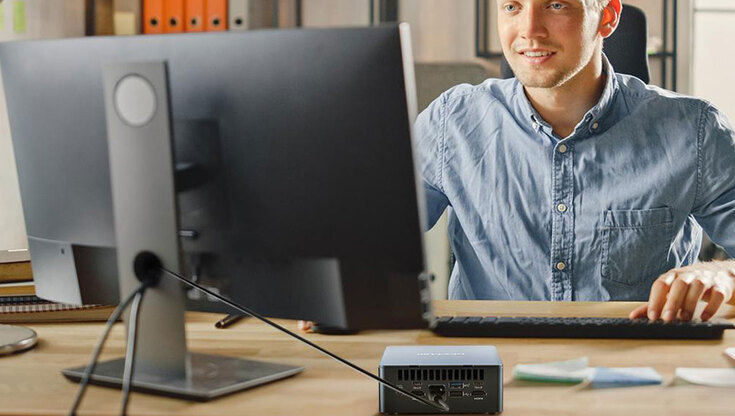
The mini PC has emerged as a formidable alternative to conventional desktop computers, offering strong performance in a significantly smaller form factor.
Desktops are not entirely disappearing, but many users are migrating to mini PCs for their convenience, efficiency, and modernity.
Top Benefits of a Mini PC Over a Traditional Desktop
A mini PC provides a smart, future-focused solution, whether one is upgrading their home office or needs a nice, travel-friendly workstation. The following are the eight best reasons to choose mini PCs.
Minimalist and space-saving design
The size of mini PCs is one of the most apparent advantages. They can be installed on small desks, behind monitors, or even on walls. In small apartments, communal work areas, or neat, clean rooms, mini computers save space without compromising functionality.
Energy-efficient performance
Compared to conventional desktops, mini PCs use much less energy, resulting in lower electricity costs and a reduced environmental impact.
Nearly all of them can run on as little as 15-65 watts, compared to 250 or more watts that full-size desktops consume. This predisposes them to long-time users who have their systems running for long hours.
Quiet, low-heat operation
Also, you should buy mini PCs because they run much quieter than tower desktops, thanks to optimized cooling and efficient components. Most have minimal to no fan noise, making them ideal for recording studios, office conferences, online classes, or working late. They are also more comfortable to be used in warm climates due to their low heat output.
Small and portable
Mini PCs are compact enough to fit in a backpack or laptop bag, so users can carry their entire workstation anywhere. You can be at work, at home, commuting to the office, or on the move; a mini PC provides desktop power in a tiny package.
High achievement of daily activities
Even though they are small, modern mini PCs have powerful processors, large storage capacity, and good graphics performance. They can easily handle daily activities such as web browsing, office applications, video calls, and streaming. Specific models are even favorable to gaming, creative work, and light content production.
Flexible internet connectivity
Mini PCs are equipped with more ports important to them, such as HDMI, USB-C, USB-A, Ethernet, audio jacks, and occasionally SD card readers.
Most of them are compatible with two or three monitors and are ideal for productivity and multitasking. They are already more connected than typical desktops and take up less space.
Easy to integrate into any setup
Mini PCs fit perfectly well in any setting, whether you are building a home theater system, a workstation in a conference room, or a digital signage display. They are small and can be hidden, mounted, or attached to the back of the screens, making setups clean and professional.
Economic and yet hardware independent
Mini PCs are usually cheaper than full-tower desktops yet offer good performance. Users also save on hardware and long-term power consumption because they do not need large cases, bulky fans, or extras. They are excellent in terms of price for the low-end customers.
Conclusion
Mini PCs are no longer a niche product; they have become powerful, efficient computers that compete with traditional desktop computers on most features.
They are small, consume less energy, portable, do not produce sound, and perform well, making them the optimal choice in the modern working environment and daily computing.

Login to Geektown