
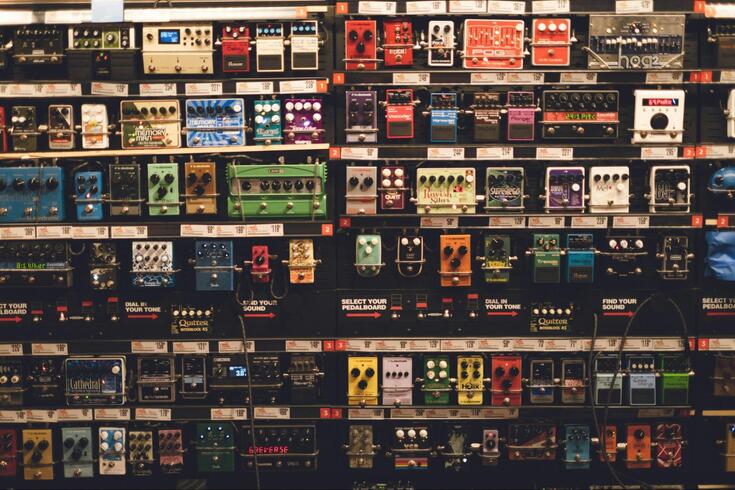
Sound is a key factor in identity, particularly among guitarists and experimental musicians. The study of tone, dynamics, and texture is a creative opportunity and a motivator to musical development. A multi-effects pedal makes this exploration easily accessible. The ability to integrate a plethora of effects into a single small unit enables the user to explore new musical directions, risk, and define their sound- all without the need to have a series of individual devices.
Encouraging Hands-On Experimentation
Multi-effects units combine dozens of modulation, distortion, ambient and dynamic effects into one box. This format challenges the players to scroll, mix, edit and re-compose sounds in real time. Rather than changing physical pedals, users can easily adjust settings and experiment with options that might otherwise go untested.
The hands-on approach reduces the distance between sound and idea. Players are more inclined to experiment with non-standard combinations, such as phaser and pitch-shifting, reverb and tremolo, or delay into fuzz. This participatory method fosters curiosity and develops intuition about how effects interact.
A Gateway to Sound Design
Tones are not fixed; they vary by shape. Multi-effects pedals provide the player with the fundamentals of sound design, signal routing, tone stacking, modulation depth, timing, and more. Studying these aspects within a single unit provides a more robust foundation for understanding tone and the rationale for its effectiveness.
The routing options available in many multi-effects units are usually complex or costly to achieve in a conventional configuration. The signal chains for series and parallel, pre- and post-processing, and stereo outputs are provided as tools, not as theory. Players can create rich layers or highly restrained tones, depending on their musical purpose, with minimal setup.
Supporting Genre Exploration
The tonal expectations of each genre are different. Classic rock is based on crunchy drive and spring reverb. Ambient music is based on modulation and overlaid delay. Funk may require envelope filters and octave shifts. These textures can be changed instantly using a multi-effect pedal.
The availability of these options makes it easier to try different genres without investing in a whole ensemble of equipment for each. In rehearsal, or on stage, players can experiment with new ideas with minimum modification. Such flexibility enables greater use of musical vocabulary and faster adaptation to working with others.
Building Confidence Through Control
Sound can influence players’ approach to their instrument. Confidence increases when a tone is appropriate. Multi-effects pedals provide fine controls, including attack sensitivity, reverb tail length, and delay subdivisions, helping players feel more in control of their sound.
The control helps minimise dependence on presets or default settings. Players are no longer content with what is there; they are editors of their own tone. Such a feeling of ownership gives a boost of confidence, not only in the equipment but also in the ability to create mood and direction on a set or session.
Expanding Practice Possibilities
Creative practice does not only involve repetition but also exploration. Multi-effects units combine backing devices, such as loopers and rhythm sections, with delay, chorus, or overdrive in the same unit. These extras support interactive practice sessions in which ideas are developed organically.
A guitarist can start a session with scale work, but once they add a looper and delay, that technical practice becomes an entire musical concept. Such random changes make practice more alive and fruitful, yielding unforeseen findings that would not be made in a routine process.
Simplifying Setup Without Sacrificing Variety
Old-fashioned pedalboards become large in no time. Replacing cables, handling power supplies, or troubleshooting the chain order can slow creativity. A multi-effects pedal eliminates that clutter without decreasing tonal range.
This simplification is helpful for players who work in common areas or move between rehearsal rooms. It allows quick installation and dismantling while maintaining sonic integrity. One unit delivers nearly all the power of a full-spectrum sound system, eliminating the need to carry multiple stompboxes.
Creating Consistency Across Contexts
Between rehearsal and performance, consistent tone helps sustain a unified identity. Multi-effects pedals enable patches to be stored and recalled immediately. Players can create sounds that correspond to specific songs or parts and activate them with a button press.
This predictability enhances timing and expression. Players are aware of what will happen and can concentrate on dynamics, phrasing or interaction with others. For musicians with multiple projects at once, consistency helps maintain a consistent voice across situations.
Pushing Beyond the Familiar
One can get in a rut by using the same overdrive sound or the same delay pattern. A multi-effects unit continues to challenge this routine by offering new possibilities with every turn. Presets, menus, or custom chains prompt players to ask, “What if?”
These minor provocations keep the creativity alive. They challenge players to step outside the ordinary and explore new horizons. These tools are not only practical for creating distinctive soundscapes but also inspirational.
A Playground for the Curious Musician
A multi-effects pedal is not merely a device, but an artistic space. It provides musicians with the liberty to explore, mould and redefine sound without resistance. The multi-effects units are a chance to learn by doing, be it in live performance, solo writing or even exploring. They allow players to regulate their tone, push limits and experience the pleasure of finding something totally unexpected.

Login to Geektown