
Thanks to the fast internet connectivity around the world, we have gotten used to immediate results. Take customer support as an example. While customers often had to email companies for solutions in the past, most organisations have adopted real-time customer support that ensures their clients get immediate answers. This immediacy also shows up in the entertainment sector, especially with online casinos. Back in the day, players would wait several days to get their earnings. But now, we have instant withdrawal casinos that have cut this time back significantly. And if you were to look at streaming services, you would find that many of them have upgraded so much that their users get to follow real-time events as if they are there.
However, that is not always the case, as some platforms are quite slow in comparison to their counterparts. We look at why these streaming platforms fall behind and how this impacts their users.
Why Are Some Streaming Services Slow?
With the high competition in the streaming industry, one would think that all providers would be at the top of their game. But some are literally lagging despite this fact. Why is this?
- Overloaded servers. Some platforms offer their services to way more users than their servers can handle. And while this often goes unnoticed during regular watching times, it becomes obvious during peak hours or when popular live events are taking place.
- Insufficient content delivery network node coverage. Where a provider has few nodes or where these nodes are far from users, data takes a long time to travel, which results in a low speed.
- Poor setups. In some cases, the streaming platforms fail to use the correct encoding or bitrate streaming, which leaves their servers struggling. Also, where platforms fail to manage their files, it is not uncommon for some videos to be in the wrong format or be corrupted, which can result in stalling or slow speeds.
It is important to note, though, that sometimes streaming services may be slow due to reasons related to the user and not the platform in itself. For example, if the user has slow internet, this could affect the streaming speed even if the streaming platform has high speed. However, where the user’s connection is good, then the onus falls on the streaming platform.
The Impact on Users.
Streaming has become the norm in the world of entertainment as it allows users to enjoy their favourite shows or events no matter where they are. But what happens when the streams are slow?
Frequent Interruptions.
The truth is that most users expect videos to play the minute they hit the play button. This expectation is especially high when viewers are watching live events such as:
- Sports,
- Concerts,
- Live shows.
In such cases, viewers heavily depend on the streaming services to keep them abreast of key moments as they take place. Even when users are not following live action, they still want immediate feedback.
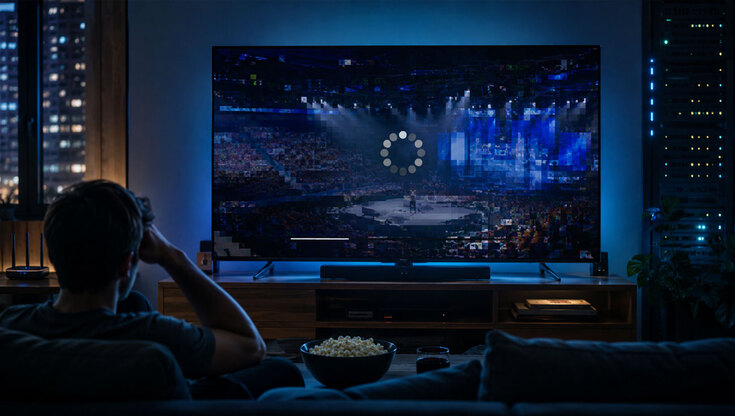
But when these services are unable to deliver data fast enough, the videos pause to buffer. To the viewer, this is a frustrating experience as they have to wait until the buffering ends before they can continue watching the show or event. What’s more, it breaks their immersion such that the longer or more often that the stream buffers, the more likely they are to close the tab and look for another streaming service.
Quality Reduction.
Watching shows or events in HD or 4K is so immersive that users have gravitated towards such quality. And while most streaming platforms are able to deliver these formats consistently, some are not. In fact, you often find that when speed suffers, streaming platforms have no option but to downgrade their resolutions so as to keep streaming the video.
For viewers, this is not a welcome change. It is even worse for viewers who have paid a subscription fee to access premium videos, only to be provided with subpar quality. Once again, this can result in dissatisfaction with the overall streaming site, and if continued, viewers can decide to opt out and look for a better service with more reliable quality.

Login to Geektown