
Well, Hollywood has apparently decided that what it really needs is fewer companies owning more things.
Paramount’s $110bn acquisition of Warner Bros. Discovery has officially completed, bringing two historic studios, an enormous collection of television brands and a frankly ridiculous amount of familiar entertainment under one corporate roof. The combined company is called Skydance, with David Ellison serving as chairman and CEO, alongside co-CEO Ynon Kreiz.
The sales pitch is familiar: a stronger competitor, more investment, better entertainment and greater value for audiences. Somewhere in there, shareholders get a mention too. Funny how they never get forgotten.
There are potential benefits here. A financially healthier business could support ambitious productions, improve its streaming technology and compete more effectively with other entertainment giants. But losing another independent major studio is a substantial price to pay for benefits that still need to materialise.
So, what changes for viewers, who now controls what, and is there anything to feel optimistic about? Let’s rummage through Hollywood’s latest corporate shopping basket.
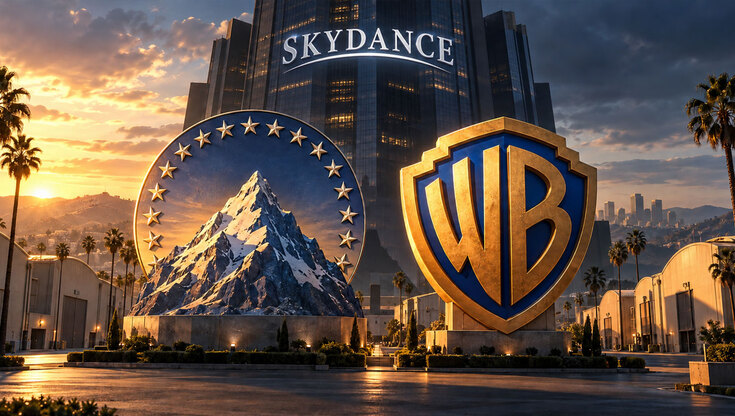
The Mountain And Shield Are Staying
First, some genuinely welcome news: Paramount and Warner Bros. are keeping their names and identities.
In their employee memo, Ellison and Kreiz explicitly state:
“Both studios will continue to operate under their own names, and audiences will still see the Paramount mountain and the Warner Bros. shield before the films and shows they love.”
Skydance is the corporate umbrella. Think broadly along the lines of Google sitting within Alphabet, rather than every familiar entertainment brand suddenly becoming Skydance Something-Or-Other.
The executives even acknowledge considering combinations such as “WarnerParamount” and “ParaWarner”. Thankfully, those appear to have stayed in the brainstorming session where they belonged.
Keeping the historic identities is the right call. Those names belong on cinema screens, not just in a nostalgic montage before an executive unveils the new branding. However, preserving two logos does not preserve two independent owners.
Just How Much Does Skydance Control?
Quite a lot. And then a bit more.
The combined portfolio includes Paramount Pictures, Warner Bros., HBO, CBS, CNN, Nickelodeon, Cartoon Network, MTV, Comedy Central, Discovery, HGTV, Food Network, TNT Sports, Paramount+, HBO Max and Pluto TV, among others.
Its franchise portfolio brings together DC Comics and DC Studios, ‘Star Trek’, ‘Game of Thrones’, ‘SpongeBob SquarePants’, ‘Teenage Mutant Ninja Turtles’, ‘Mission: Impossible’ and ‘Top Gun’, alongside major screen interests in ‘Harry Potter’, ‘Transformers’ and ‘The Lord of the Rings’.
The games business is part of this too, including the businesses behind ‘Mortal Kombat’ and ‘Hogwarts Legacy’. This reaches beyond what gets commissioned for your television or released at your local cinema.
There is an important distinction here: franchise rights are complicated. Producing or distributing screen adaptations does not necessarily mean owning the underlying books, characters or every associated right. Similarly, broadcasting a sport does not mean owning the league.
Nevertheless, the concentration is enormous. And with CBS News and CNN also within the group, its reach extends beyond entertainment into major news organisations.
The official announcement also makes the voting structure clear: the Ellison family and RedBird Capital Partners together hold 100% of the combined company’s voting shares. RedBird is a private investment firm founded by financier Gerry Cardinale, specialising in sports, media and entertainment, alongside financial services. It has helped finance Skydance’s expansion and shares ownership control with the Ellisons. Other investors own equity, but shareholder voting power rests entirely with those two interests.
For anyone concerned about power over commissioning, distribution and investment, that is considerably more concrete than simply pointing out that the chairman has a billionaire father.
Will Paramount+ And HBO Max Merge?
Yes, that is now the stated plan. Skydance’s official announcement says its streaming products “will unify into a single service over time”.
That goes further than offering a bundle. The intended destination is one service, although the announcement does not provide a timetable, final branding or subscription prices.
For someone currently paying for both Paramount+ and HBO Max, a combined library could be convenient and potentially better value. One subscription, fewer apps and less time trying to remember which service has the programme you wanted to watch. There is a perfectly reasonable consumer benefit there.
The awkward bit is the bill. A combined subscription could save money for someone paying for both services while costing more for someone who only wanted one. Until Skydance supplies the numbers, “better value” belongs in the sales pitch rather than the list of confirmed benefits.
Disney+ offers a useful reminder. Its UK launch price was £5.99 a month. Its current regular monthly prices are £5.99 with adverts, £9.99 for Standard and £14.99 for Premium. The catalogue and subscription tiers have changed, so this is not a perfectly identical comparison, but it demonstrates how quickly an appealing introductory proposition can become a rather more expensive household habit.
Apparently, the magic costs extra now.
Skydance could pass some savings on to subscribers. It could also use its larger library to justify higher prices. Neither outcome is guaranteed, and corporate enthusiasm for “synergies” does not automatically translate into a cheaper direct debit.
Meanwhile, HBO Max could be heading towards another identity crisis. At this point, the app icon probably needs its own therapist.
This Reaches British TV Too
For UK viewers, this is more than a distant Hollywood boardroom shuffle. 5, formerly Channel 5, was already owned by Paramount, so it now sits within the wider Skydance group. Paramount+ and HBO Max are also part of the British streaming landscape.
As an aside, the UK has its own consolidation story unfolding. In a separate deal, unrelated to the Skydance acquisition, Comcast-owned Sky has agreed to buy ITV’s broadcasting and streaming business, including its channels and ITVX, for up to £1.6bn. That acquisition has not completed, and ITV Studios would remain separate.
Different deal, similar questions about how many independent owners will be left behind those familiar television brands. Sky is not becoming part of Skydance, despite the names sounding like someone has accidentally ordered the same company twice.
Who Owns What In Hollywood Now?
It would be tempting to describe this as Disney on one side, Skydance on the other and everyone else hunting for loose change down the sofa. The actual picture is more complicated.
Here is a simplified map of the major groups, rather than an exhaustive list of every subsidiary or licensing arrangement:
| Group | Major studios, brands and services |
|---|---|
| Skydance | Paramount, Warner Bros., DC Comics and DC Studios, HBO, CBS, CNN, Nickelodeon, Discovery, Paramount+, HBO Max, Pluto TV and 5 |
| Disney | Walt Disney Pictures, Pixar, Marvel Studios, Lucasfilm, 20th Century Studios, Searchlight, ABC, Disney+, Hulu and ESPN |
| Comcast / NBCUniversal | Universal Pictures, DreamWorks Animation, Illumination, Focus Features, NBC, Bravo, Peacock and Sky |
| Netflix | Its global streaming service, production operations and substantial commissioned and licensed catalogue |
| Sony | Columbia Pictures, TriStar, Screen Gems, Sony Pictures Television and Crunchyroll |
| Amazon | Amazon MGM Studios, Prime Video, MGM’s library and joint ownership of the James Bond franchise, with creative control |
| Apple | Apple TV, Apple Studios and its commissioned and acquired film and television slate |
| Lionsgate | Lionsgate’s film and television studios and franchise library; Starz is a separate company |
Comcast has announced plans to separate NBCUniversal, including Sky, into its own public company, but that separation has not yet completed.
These groups also have different strengths. Universal was the first studio to pass $5bn at the global box office this year. Netflix ended 2025 with more than 325 million paid memberships. Neither is exactly a plucky little outfit hoping somebody will notice its Kickstarter.
Amazon and Apple complicate the economics further. Entertainment can support Prime membership, customer loyalty, subscriptions and a wider ecosystem of products and services. That gives them more flexibility than a business dependent primarily on entertainment revenues.
However, describing their entire television operation as an advertising budget goes too far. They still have commercial objectives, budgets and reasons to cancel programmes. Ecosystem benefits can justify investment without making every production an intentionally loss-making advert for a phone or next-day delivery.
So, Skydance is not a monopoly, and Disney is not its only serious rival. Competition also looks different depending on whether we are discussing cinema releases, streaming subscriptions, sports rights or buying scripts from writers. You cannot settle all of those questions with one league table of company size.
The strongest argument for the merger is that scale may help Paramount and Warner Bros. compete with those rivals. The strongest objection is that making one competitor bigger also removes an independent competitor from the market. Both can be true.
What Happens To The People Making The Programmes?
For writers, producers and other creatives, fewer independent buyers can mean fewer places to pitch, fewer alternative employers and less leverage when negotiating terms.
A project rejected by Paramount could previously be taken to an independently owned Warner Bros., and vice versa. Separate creative teams may continue making different decisions, but their budgets and wider strategy now sit beneath the same corporate leadership.
Skydance says it will continue commissioning from independent studios and licensing its own content to third parties. That might prompt a cautious sigh of relief at Sky, which has already watched Disney reclaim dramas such as ‘Grey’s Anatomy’, ‘9-1-1’and‘9-1-1: Lone Star’ for Disney+ UK. Given how much of Sky Witness’s schedule relies on CBS dramas, another supplier deciding to take its toys home would hardly be welcome news.
Before anyone gets too comfortable, though, ‘Sheriff Country’ and ‘Boston Blue’ both landed on Paramount+ UK, despite their parent shows, ‘Fire Country’ and ‘Blue Bloods’, having established homes on Sky. Apparently, keeping the television family together does not necessarily extend to keeping it on the same subscription.
Then there is ‘NCIS’ Season 23, whose prolonged absence from Disney+ UK had us wondering whether Paramount was following Disney’s example and reserving more of its programmes for its own platform. Disney had even told viewers it did not have the UK streaming rights. Only for the season to suddenly appear this October, months later than expected, without an explanation for the delay or the apparent change in position. For a procedural built around solving mysteries, its UK distribution has been remarkably good at creating them.
None of this establishes a blanket withdrawal from outside platforms. It does demonstrate why a broad licensing promise offers limited reassurance about any particular programme. Skydance can keep selling some shows to other services while reserving others for itself.
So yes, continued licensing could preserve opportunities for independent producers and keep programmes available beyond Skydance’s own service. But the announcement supplies no quantified minimum, no guarantee for particular franchises and, sadly, no commitment to tell UK viewers where their next season has wandered off to.
Then there is the financial elephant occupying most of the boardroom: the combined company starts with roughly $80bn in debt and is targeting at least $6bn in annual savings once fully implemented, within three years.
That is an annual savings target, not simply $6bn saved cumulatively across three years. Skydance says the savings will come primarily from technology, integration, procurement, marketing and property changes. Those categories do not all mean job losses, but employees are plainly part of the difficult decisions ahead.
Ellison and Kreiz acknowledge this directly in their memo:
“Integrating two companies will bring change, including difficult decisions that affect our workforce.”
Promises to support creativity will therefore arrive alongside pressure to reduce costs. For the people making the entertainment, the practical question is whether the new business offers more opportunities than it removes.
The Investment Promises Deserve A Closer Look
The merger settlement contains commitments with real substance. These include minimum theatrical output, protections for the historic studio lots and additional US production spending.
The theatrical requirements rise from 30 films annually in the first two commitment years to 32 in the following three, with minimum numbers of wide releases and support for independent films. The settlement also establishes minimum theatrical windows. These are more meaningful than a vague promise to keep Hollywood busy.
The much-discussed $1.5bn in additional US production spending over five years means an extra $300m annually above the two companies’ combined 2025 US production spending. It is a spending commitment, not a government cheque handed to Ellison.
For perspective, Skydance says the combined businesses spent more than $30bn on content globally over the preceding twelve months. That is not an identical comparison: global content spending and additional US production spending cover different things. Nevertheless, it helps explain why $300m can be meaningful money for individual productions while remaining a modest increment within this enormous business.
The bigger issue is where it goes. A spending floor does not guarantee a diverse range of stories, protect every production job or require every extra dollar to be invested in California. Management still decides which projects, locations and creative voices receive that money.
That concern became particularly tangible when Paramount reportedly threatened to move operations out of California during the dispute over the merger. California Attorney General Rob Bonta described the pressure as “blackmail”. Whatever label you prefer, threatening to take jobs and investment elsewhere is a fairly unsubtle way of applying pressure to a state government.
Of course, moving “operations” would not necessarily have meant relocating the Paramount or Warner Bros. studio lots, or ending production in California. Nobody was going to load the Paramount gates onto a removal van and ask whether Texas had somewhere suitable to put them. Headquarters and support roles can move, while future productions can be directed towards other states or countries. The lots can remain recognisably Hollywood even as more of the work happens elsewhere.
The settlement protects those lots against sale or closure during its commitment period, which is welcome. But protecting historic buildings is different from securing the productions and jobs that make them working studios. The additional spending commitment covers the US as a whole, rather than California specifically, leaving Skydance considerable freedom over where that money goes.
That is where the concentration of power becomes more than an abstract argument about who owns which franchise. Decisions made by one corporate leadership team can affect livelihoods across an entire production community. A promise to spend more money is useful, but it leaves the same small group deciding who gets it, where it lands and what strings might be attached.
And Then There’s The AI Bit
The staff memo also explicitly embraces AI, with Ellison and Kreiz saying it can expand creative possibilities and make the business more productive. They promise that “technology must serve the art”.
That is a sensible principle. Better tools could help filmmakers achieve things previously beyond their budgets, improve production processes and make services easier to use. Technology can be useful without becoming the star of the show…
The question is how that principle survives contact with the savings targets. Neither the AI enthusiasm nor the workforce warning proves that particular creative jobs will be replaced. Together, though, they give workers good reason to scrutinise what “more productive” eventually means.
Corporate enthusiasm for efficiency tends to sound rather different depending on which side of the redundancy email you occupy…
Bigger Is Easy To Measure. Better Will Take Some Proving
There are plausible positives. More financial backing could support ambitious productions. A combined streaming service could offer better value. Shared technology could improve the viewing experience. The theatrical commitments, studio protections and additional production spending offer tangible safeguards.
Preserving Paramount and Warner Bros. as creative identities is welcome too. A bigger owner does not automatically make every film worse, every programme blander or every subscription more expensive.
But… none of that settles whether swallowing another major studio was the right response to Hollywood’s problems. The loss of independent ownership has happened immediately. The promised benefits will arrive later, if management delivers them.
Skydance argues that the merger will strengthen competition and expand consumer choice. It may indeed become a tougher rival to Netflix, Disney and others. But a larger catalogue within one company does not give creatives another independent buyer, or viewers another independently owned provider.
My concern is about the structure as much as the individuals running it. Good intentions today cannot guarantee how this collection of studios, franchises, news organisations and distribution platforms will be managed in five or ten years.
Personally, I would have preferred to preserve that competition unless a much stronger case for the merger’s necessity and public benefit had been established. The investment promises deserve recognition, but they do not replace the independent owner that has disappeared.
I would be delighted to see better programmes, healthier production and genuinely better-value subscriptions prove the scepticism misplaced. Until then, I’m keeping the champagne in the fridge.
The mountain and shield are staying. Whether viewers and creatives benefit from the company standing behind both is the much bigger question…

Login to Geektown