
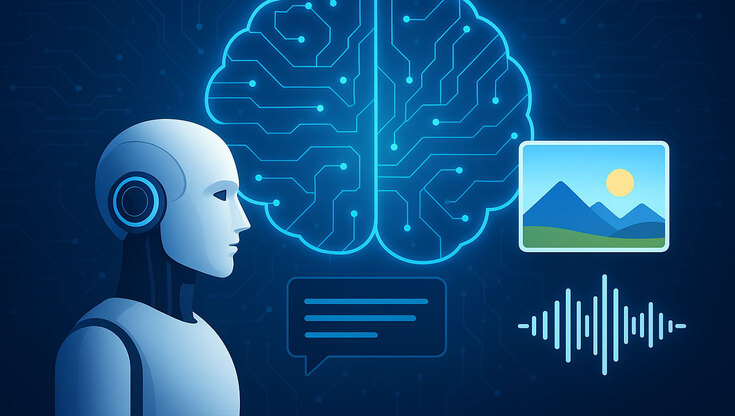
Artificial intelligence has come a long way, especially with the rise of large language models (LLMs) that can generate and understand human language. But the next big step is already on the horizon: multimodal LLMs that can handle not just text, but also images and voice, all at once. For AI and machine learning enthusiasts, this is an exciting development that promises more natural and intuitive interactions with technology. But how close are we to achieving this seamless blend, and what challenges still stand in the way?
Understanding Multimodal AI
Multimodal AI refers to models that can process and generate multiple types of data—such as text, images, and audio—together. This approach is much closer to how humans naturally communicate, switching between speaking, writing, and showing visuals without missing a beat. The potential applications are vast, from smarter virtual assistants to more accessible technology for people with disabilities.
Some online platforms, like Fortunica, are already exploring how AI can enhance user experiences, though true multimodal integration—where text, images, and voice are handled seamlessly in real time—remains a work in progress across most industries.
At its core, multimodal AI aims to:
- Enable richer, more human-like interactions with machines;
- Improve accessibility for diverse users;
- Increase the context-awareness of AI systems.
Where Are We Now? Current Capabilities and Gaps
The progress in multimodal LLMs has been impressive, but there are still clear limitations. Today’s best models can perform a range of tasks across different data types, but often struggle to combine them smoothly in a single, ongoing conversation.
To illustrate what current models can and cannot do, let’s look at their main strengths and weaknesses.
Currently, multimodal LLMs can:
- Generate text descriptions for images (image captioning);
- Answer questions about pictures (visual question answering);
- Convert speech to text and vice versa;
- Perform basic cross-modal reasoning.
However, these abilities are often siloed. Most models can only handle one or two types of data at a time, and switching between them can be clunky.
Below is a table comparing some of the leading multimodal AI models and their capabilities.
| Model Name | Text Understanding | Image Processing | Voice Processing | Seamless Integration |
| GPT-4o | Yes | Yes | Yes | Partial |
| Gemini | Yes | Yes | Yes | Partial |
| LLaVA | Yes | Yes | No | Limited |
| Kosmos-2 | Yes | Yes | No | Limited |
As you can see, while text and image capabilities are strong, seamless integration—especially with voice—is still developing.
What’s Holding Back Seamless Multimodal AI?
Despite the promise, several technical and practical challenges are slowing down the journey toward truly seamless multimodal LLMs. Understanding these hurdles is key for anyone interested in the future of AI.
The main obstacles include:
- Unified data representation: It’s difficult to train models that can understand and relate text, images, and audio in a unified way.
- Computational requirements: Handling multiple data types at once demands significant processing power and memory.
- Context switching: Keeping track of context when users switch between speaking, typing, and showing images is complex.
- Training data: High-quality datasets that include text, images, and voice together are still relatively rare.
- Ethical and privacy concerns: Processing images and voice raises important questions about data security and bias.
To tackle these issues, researchers and developers are working on several strategies. Here are some of the most promising approaches:
- Creating larger and more diverse multimodal datasets;
- Designing more efficient neural network architectures;
- Improving context memory within models;
- Incorporating user feedback to refine AI responses.
How Soon Will We See Seamless Multimodal LLMs?
Predicting the exact timeline for seamless multimodal integration is challenging, but there are reasons to be optimistic. Advances in hardware, data collection, and model design are accelerating progress. Many experts believe that in the next three to five years, we’ll see AI systems that can blend text, images, and voice in real time for a wide range of applications.
Here are some key developments to watch for as this technology matures:
- Open-source projects that share models and datasets;
- Adoption of multimodal AI in sectors like healthcare, education, and entertainment;
- User-centric design that puts real-world needs at the centre of model development;
- Improved accessibility tools for people with disabilities;
- Virtual assistants that can handle complex, multimodal conversations.
The Pros and Cons of Multimodal LLMs
As with any new technology, there are both advantages and drawbacks to consider. Understanding these can help you form a balanced view of where multimodal AI is heading.
Here’s a summary table of the main pros and cons:
| Pros | Cons |
| Access to richer, more natural interactions | Potential privacy concerns |
| Improved accessibility for diverse users | High computational demands |
| Greater context awareness and relevance | Reliance on large, high-quality datasets |
| New possibilities for virtual assistants | Complexity of context switching |
The Road to Seamless Multimodal AI
Multimodal LLMs are set to transform how we interact with technology, making AI more natural, accessible, and useful than ever before. While today’s models are impressive, the journey to seamless integration of text, images, and voice is still ongoing. By staying informed and engaged with the latest research and tools, AI enthusiasts and practitioners can help shape the future of this exciting field.
Are you ready to experiment with multimodal AI or contribute to its development? Keep an eye on emerging models, join open-source projects, and share your experiences—because the next leap in AI is just around the corner.

Login to Geektown