
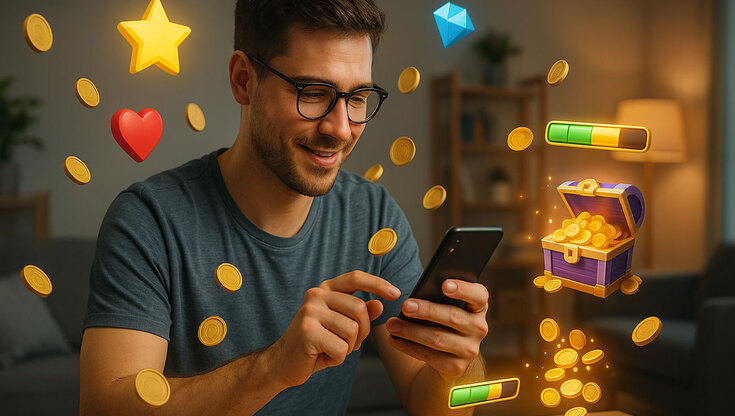
Remember when gaming meant a clunky console, a wired controller and maybe a dodgy memory card that wiped your save file right before the final boss? Simpler times. These days, gaming logic has escaped its cartridge-shaped box and spilled into everything else. From fitness apps to banking, nearly every part of modern life now feels a little like a game.
We chase badges on running trackers, unlock achievements for drinking enough water and get “You’re on fire!” notifications from apps that are far too proud of our sleep schedules. The entire internet now speaks the language of XP, levels and streaks. Whether you are learning Spanish or doomscrolling Twitter, you are probably playing something without even realising it.
The dopamine loop that started it all
It all comes down to one small chemical: dopamine. Every time a game dings, flashes or praises us, our brains release a burst of pleasure. Developers have been using that reaction since Space Invaders first beeped triumphantly in the 1970s. Now the rest of the tech world has caught up.
Social media uses likes and follows the same way RPGs use gold coins. Productivity apps celebrate you for ticking boxes. Even your smartwatch treats standing up once an hour as if you have just saved the galaxy. It is no wonder so much of life feels like we are grinding XP in an endless side quest called “adulthood.”
The age of gamified everything
The word for this is gamification: using gaming mechanics in places that have nothing to do with actual games. It is why Peloton lets you race strangers across the globe. It is why Duolingo sends a furious owl when you skip a day. Even finance apps now throw fireworks across the screen when you manage to save twenty pounds.
The reason it works is simple. People love visible progress. You might not notice if you have become a better writer, coder or runner, but if your app tells you that you have hit 90 percent of your daily goal, that feels like an achievement. It is that same itch that kept you replaying Tetris at 3am because you were so close to breaking your high score.
We dug into this idea before in our look at how gamification became the key to app engagement, and it has only accelerated since. The modern web is built around tiny dopamine loops that make progress feel playable, even in non-gaming spaces.
The entertainment overlap
It is not just fitness or productivity. Entertainment itself has become gamified. Streaming services use watch streaks and “continue watching” bars to keep us engaged. Mobile apps hand out daily bonuses just for logging in. And in the world of online casinos, the same interactive design has evolved from static card tables into slick, video game-style experiences with levels, avatars and seasonal challenges.
If you want to see where that crossover between gaming and online entertainment is most visible, take a look at the top 20 best online casinos. Many now feature the kind of sound design, progression systems and visual polish that would feel right at home in a mobile RPG.
This crossover is everywhere. Sports teams and entertainment brands are experimenting with similar techniques, as seen in our breakdown of gamification, NFTs and fan engagement in the Premier League.
Why we cannot resist the grind
Psychologists call it variable reward scheduling. It is the idea that unpredictable rewards keep us engaged longer, the same principle that keeps gamblers pulling levers, social media users refreshing feeds and gamers looting dungeons. Every spin, refresh or click carries the promise of something shiny.
You do not even have to win to feel the pull. Just the possibility is enough. That is why you feel compelled to fill progress bars, finish side quests or open one more mystery box in Overwatch. Our brains hate leaving things incomplete. We are, by design, natural completionists.
For a clear primer on how unpredictable rewards shape habits, see this Psychology Today explainer.
Ethics, loot boxes and the fine print of fun
Of course, when everything becomes a game, someone will eventually try to exploit the players. The debate around loot boxes, microtransactions and compulsive design has made even the biggest studios rethink how they use reward psychology. Gamification is powerful, and like any tool, it can be used for good or bad.
Thankfully, more developers and app designers are leaning towards healthy systems that motivate rather than manipulate. Fitness apps now encourage rest days. Education platforms reward consistent effort instead of endless grinding. The best ones understand that dopamine should be a spark, not a leash.
For anyone curious about the science behind these effects, Frontiers in Psychology published a useful meta-analysis on gamification and motivation that shows how design can both inspire and overwhelm depending on implementation.
Learning from play
For all its pitfalls, gamification has given us a valuable new way of seeing the world. Games taught generations that failure is not final; it is just another checkpoint. That attitude has quietly reshaped classrooms, offices and online spaces. “Levelling up your skills” feels friendlier than “improving your weaknesses.” It is progress with personality.
Even beyond the screen, the world is being reimagined as a playable space. Cities now run apps that reward people for recycling. Museums create augmented reality quests that turn history into adventure. Charities use leaderboards to make fundraising social and competitive. Everywhere you look, life has been redesigned to feel a little more like a game.
When life itself levels up
We are moving toward a world where gamification will not even feel like a design choice. It will simply be how digital life works. Artificial intelligence could start adjusting your daily challenges automatically, nudging you toward slightly harder goals as you improve. Augmented reality might mix the digital and the physical until errands feel like side missions. The real world could become one big open-world RPG, complete with social quests and achievement pop-ups.
Whether that sounds exciting or exhausting depends on your inner geek. Some will see endless motivation. Others will see an infinite grind. Either way, it is clear that this is who we are now: the gamified generation.
We have absorbed the mechanics of play so completely that they shape how we think, learn and relate to each other. Points, badges, streaks and bonuses are no longer game features; they are cultural habits. Maybe that is fine. Maybe we just evolved to need feedback, to want to know we are getting somewhere, even when the world feels like an endless boss fight.
And if life really is a game, then we are the first generation to recognise it and start playing it intentionally.

Login to Geektown