
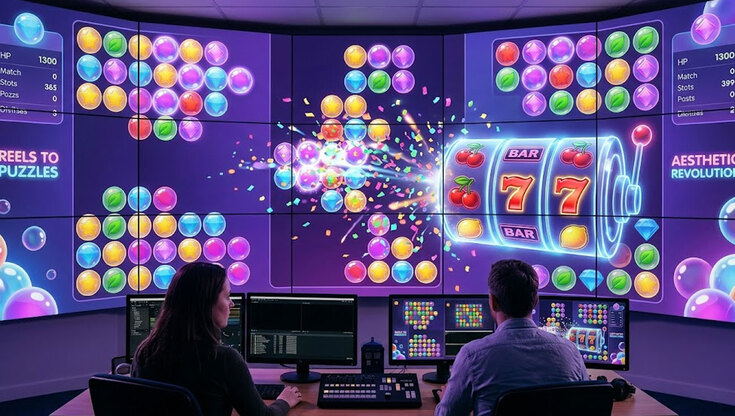
If you have spent any time scrolling through a mobile app store or browsing an entertainment news site lately, you have probably noticed something quite striking. The games we play on our lunch breaks or while waiting for the train don’t look or behave like they used to. There is a certain shift happening where the lines between different genres are becoming so blurred that it is hard to tell where a puzzle game ends and a traditional slot machine begins. This isn’t just a coincidence; it is a calculated move by designers to create a more cohesive and engaging experience for everyone involved.
For those of us who follow the latest trends in entertainment and tech, this evolution is fascinating. We are moving away from the rigid structures of the past and towards a more fluid, “juicy” style of interaction. It is a world where every click feels satisfying, every win is accompanied by a burst of colour, and the mechanics themselves are designed to be as intuitive as possible.
The Convergence of Media: Why Geektown is Watching Gaming UX
You might wonder why a community dedicated to the latest in television, film, and geek culture would be so invested in the user experience (UX) of casual games. The answer lies in how we consume media today. We are no longer just passive viewers; we are active participants. The same visual language that makes a high-budget sci-fi series look incredible is being used to design the interfaces of the games we play on our phones.
I find that the crossover between these industries has never been more apparent. When you look at the sleek, minimalist designs of modern streaming platforms, you can see that same DNA in the latest gaming releases. Designers are obsessed with making sure that the user never feels lost. They want the transition from one screen to the next to feel like a natural part of the story.
In the world of pop culture, “Geektown” represents a hub where these different interests collide. We see how a popular film franchise might inspire the aesthetic of a mobile game, or how the tactile feedback of a handheld console influences the way we interact with our smart home devices. Gaming UX is essentially the vanguard of this movement. It is where new ideas are tested before they filter down into the rest of our lives. If a game can figure out a way to make a complex menu feel simple and rewarding, you can bet that a television interface or a social media app will be copying that logic within a year.
The convergence of media means that we expect a certain level of polish. We want our entertainment to be “seamless,” a word that gets thrown around a lot but actually means something quite specific in this context. It means that there is no friction between the player and the experience. Whether you are watching a show or playing a quick round of a puzzle game, the visual cues should tell you exactly what to do without needing a manual. This shared visual language is what keeps us coming back. It is comfortable, it is familiar, and it is increasingly beautiful to look at.
The ‘Juicy’ UI: Decoding the Visual Language of Pop Culture Gaming
Have you ever noticed how some games just feel “better” than others, even if the core gameplay is virtually the same? That feeling is often referred to by developers as “juice.” A juicy user interface (UI) is one that over-delivers on feedback. If you press a button, it doesn’t just change state; it bounces, it glows, and it might even make a satisfying “pop” sound. It is all about making the player feel like their actions have a tangible impact on the world they are interacting with.
In the realm of pop culture gaming, this aesthetic has become the gold standard. We have moved far beyond the static images and clunky menus of the early 2000s. Today, everything is about movement and vibrance. The colours are bright and saturated, the animations are smooth, and the entire screen seems to breathe. This isn’t just about looking pretty; it is about keeping our attention in a world where we are constantly being bombarded with notifications and distractions.
Think about the most successful mobile puzzles. They don’t just clear a row of icons; they cause an explosion of light and sound. This high-engagement feedback loop is designed to trigger a sense of satisfaction. It is the same reason why social media apps use specific shades of red for notifications or why high-end car manufacturers spend millions on the sound a door makes when it shuts. We are sensory creatures, and we respond to these cues on a very basic level.
Many of us have experienced that “just one more go” feeling, and much of that is down to the UI. When the visual language is this polished, the act of playing becomes a form of relaxation. It is a low-stress way to engage with a piece of technology. By stripping away the “gaming” jargon and focusing on universal symbols and satisfying animations, developers have opened up these experiences to a much wider audience. It is no longer about being a “hardcore gamer”; it is about enjoying a well-crafted piece of interactive media that fits into your lifestyle.
Mechanical Evolution: The Shift to Cluster Pays and Cascading Logic
While the visuals have been getting a makeover, the underlying mechanics have been undergoing an even more radical transformation. For a long time, if you were playing a game involving reels, you were looking for lines. You needed three matching symbols to sit neatly in a row to get any sort of result. But as casual gaming has evolved, these traditional structures have started to feel a bit dated.
The shift towards “Cluster Pays” and “Cascading Reels” is perhaps the most significant change in the last decade. Instead of looking for a specific line, you are looking for groups or clusters of symbols that touch each other. When a match is made, those symbols don’t just stay there; they disappear, and new ones drop down from the top to fill the gaps. This creates a chain reaction, where one single action can lead to a whole series of events.
If this sounds familiar, it is because it is the exact same logic used in almost every major mobile puzzle game. This mechanical evolution has bridged the gap between different styles of play. When you look at something like the bouncy bubbles slot, you can see this logic in action. It is a prime example of how the “Bubble Pop” aesthetic and cascading mechanics have been integrated into a more traditional format. It feels less like a static machine and more like a dynamic puzzle.
This cascading logic (often called Avalanche Reels in technical circles) adds a layer of momentum to the experience. It is much more visually interesting to watch symbols tumble and pop than it is to watch a reel simply stop spinning. It creates a sense of “what happens next?” that keeps the gameplay feeling fresh. For the UK casual gaming market, this has been a game-changer. It takes the familiar comfort of a puzzle game and applies it to a broader context, making the transition between different types of apps feel much more natural.
Casual Cross-Pollination: How Bouncy Bubbles Bridges the Slot-Puzzle Gap
The ultimate result of all this innovation is a phenomenon we can call casual cross-pollination. This is where the best elements of different genres are harvested and replanted elsewhere to create something new. We are seeing a generation of games that don’t want to be put in a box. They take the social aspects of one genre, the mechanical depth of another, and the “juicy” aesthetics of a third.
The “Bubble Pop” style is particularly effective here. Bubbles are a universal symbol of lighthearted fun; they are round, colourful, and incredibly satisfying to pop. By using this as a central theme, developers can create an environment that feels welcoming and accessible. It doesn’t feel like you are engaging with a complex mathematical engine; it feels like you are playing with a digital toy. This is why titles that bridge the gap are so successful. They offer a familiar entry point for people who might not usually consider themselves gamers.
As we look towards the future, it is clear that this aesthetic revolution is only just beginning. We can expect to see even more integration between our favourite media and the games we play. The boundaries will continue to thin until the experience is entirely seamless. Whether you are a fan of the latest geek culture trends or just someone who enjoys a quick puzzle on the way to work, these changes are making our digital lives a little bit brighter and a lot more engaging.
It is an interesting time to be watching this space. The way we interact with screens is changing, becoming more tactile and more rewarding. By focusing on the “joy” of the interaction rather than just the end result, designers are creating a world of casual gaming that is truly for everyone.
Please remember to keep things fun and play responsibly. It is important to set your limits and stick to them. Never spend more than you can afford to lose. For more information and support regarding responsible gambling, you can visit BeGambleAware.org or GamStop.

Login to Geektown