
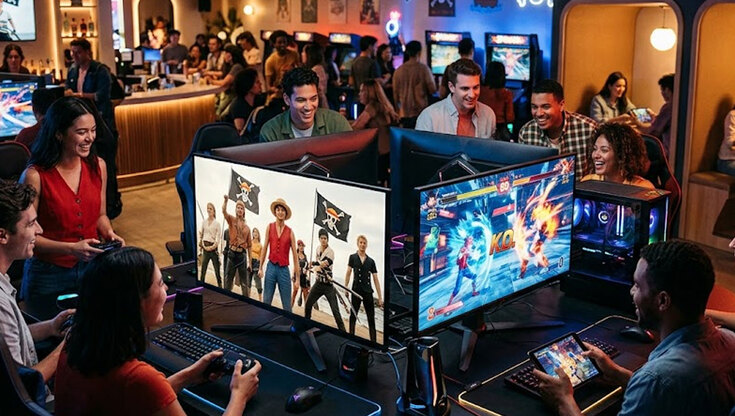
Ask anyone who watched the live-action One Piece land on Netflix what surprised them most, and the answer rarely involves Luffy’s stretching arms or the Going Merry bobbing across the screen. It is the sheer reach of the thing. A pirate saga that began as a Japanese manga decades ago somehow became one of the most talked-about shows on UK televisions, and from there the conversation didn’t stop at the screen. It rolled outward into merchandise, mobile titles, console arena fighters, and the broader pool of geek entertainment people reach for once an episode ends — a pattern fans saw with Demon Slayer and Jujutsu Kaisen before it.
That spillover is the real story. When a franchise gets big enough, it stops being a single show and becomes a flavour that turns up everywhere — including the digital leisure corners adults browse late at night. For UK readers chasing that anime-themed entertainment, a non Gamstop casino UK is one of the options worth understanding, and a 2026 guide to new sites of this kind explains exactly how they work. These casinos operate outside UKGC and GamStop rules, holding international licences such as MGA or Curacao instead of domestic ones. It recommends specific casinos, details their sprawling game libraries, runs through payment methods including crypto, and lays out welcome offers that differ from home-based sites. Crucially, it also points readers toward responsible gambling resources, which makes it a sensible first stop for a fan curious about anime-styled reels.
A Pirate Crew Built for Crossover
One Piece was always going to travel well. The colours are loud, the characters are instantly recognisable, and the world is stuffed with the kind of imagery — treasure, ships, exotic islands — that designers love to borrow. Netflix’s adaptation gave the whole thing a fresh coat of paint and a new audience who had never touched the manga.
Not everyone was won over at first. The Guardian’s beloved Japanese saga lands verdict was lukewarm, suggesting the show arrived with more spectacle than soul. Yet lukewarm reviews rarely dent a juggernaut. Word of mouth did the heavy lifting, and before long the series had carved out a permanent spot in streaming conversations across the UK. That momentum is exactly what makes a property attractive to designers far beyond television — once a name is everywhere, it becomes a shorthand for fun.
When TV Worlds Become Game Worlds
The traffic between screens and games is nothing new. Geek culture has watched it happen for years, and the BBC was already documenting the crossover following Skylanders when toys-to-life titles proved that entertainment franchises could flow freely between formats. A character could be a cartoon one moment, a plastic figure the next, and a playable hero after that.
Anime sits right in the sweet spot of this trend. Series like Demon Slayer, Jujutsu Kaisen, and One Piece arrive with built-in visual identities that translate beautifully into interactive formats. Mobile games chase the licences. Console developers build sprawling arena fighters around them. And the same recognisable artwork — the bold outlines, the dramatic poses, the sweeping soundtracks — finds its way into slot-style entertainment, where designers chase the feeling of a beloved world rather than the official badge. A reel themed around pirate treasure or ninja duels taps into the same nostalgia that keeps fans rewatching the source material.
Why UK Audiences Sit at the Centre
British viewers have become some of the most enthusiastic consumers of imported entertainment going. Netflix, Sky, and the rest have trained UK audiences to treat a Japanese saga or an American premiere as routine weekend viewing. That appetite explains why anime-adjacent gaming has such a comfortable home here.
The pattern is straightforward. A UK fan finishes a binge, wants more of that universe, and starts hunting around for anything that scratches the same itch — a game, a comic, a themed reel, a podcast breaking down the episode. The entertainment ecosystem has grown so interconnected that one interest naturally leads to another. It is the digital equivalent of leaving a cinema and heading straight to the gift shop, except the gift shop never closes and stretches across half the internet.
The Numbers Keep the Cycle Spinning
None of this works without continued success, and One Piece keeps delivering. When its second season sailed straight to Netflix’s top ten, it confirmed what fans already suspected: the adaptation had genuine staying power rather than novelty buzz. A show that performs like that gives every connected industry a reason to keep investing.
Strong viewership figures translate into bigger merchandise runs, more ambitious tie-in games, and a longer shelf life for the franchise’s visual language. Designers across the entertainment spectrum watch those charts closely, because a property climbing the rankings is a property worth borrowing from. The healthier the show, the more its imagery seeps into everything orbiting it — including the slot themes and gaming experiences UK adults browse for a bit of low-stakes fun.
A Single Thread Running Through Modern Fandom
Step back and the picture is clear. The live-action One Piece is not just a television success; it is a case study in how modern entertainment refuses to stay in one lane. A manga becomes a streaming hit, the hit becomes a game, the game becomes an aesthetic, and that aesthetic surfaces in the wider world of adult digital leisure.
For UK fans, that means the line between watching, playing, and exploring has all but vanished. The same evening that begins with a Netflix episode can drift toward a mobile fighter, a themed reel, or a podcast deep-dive without anyone feeling they have changed activities. One Piece simply happens to be the latest franchise illustrating how seamlessly those worlds now flow into one another.

Login to Geektown