
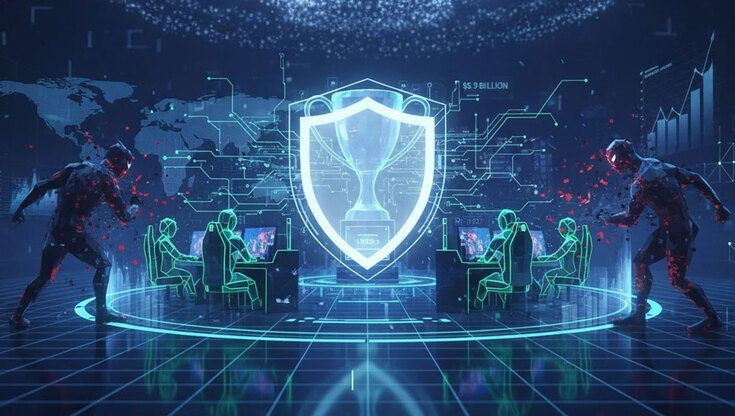
Esports have grown in popularity in the last few years. Although it started as nothing but a fun hobby, it has now become a massive industry with fans and a wide range of money-winning opportunities for pro players. As time goes on, the market is expected to get even bigger.
Nowadays, eSports is not just about playing a match or two. It’s about strategy, involvement, worldwide tournaments, and even eSports betting. You can make it big with eSports, whether as a player, a streamer, or a bettor.
However, as you go on with your daily life, waiting for the next big event, cybersecurity threats might be lurking in the shadows. So, how can eSports organisations and events protect user data? Let’s explore some solutions that companies can use to handle cybersecurity threats.
What Are the Most Common Cybersecurity Threats in eSports?
With the eSports industry getting so big, it isn’t surprising that cybercriminals are trying to find all sorts of ways to compromise systems or interrupt events. The eSports market is expected to reach a volume of $5.9 billion by 2029. Moreover, the number of users might get to 896 million by that same year.
Unfortunately, this means that organizations must also brace themselves for the influx of actors who will do everything they can to ruin the fun for everyone.
Cybersecurity threats are evolving at a steady pace, adapting to the current environment and coming up with ways to bypass existing security measures.
Here are the main cybersecurity dangers that affect the eSports landscape:
Exploits and Cheating Hacks
One way that hackers could disrupt eSports events and lower trust in the gaming community is via cheating hacks and exploits. Things such as speed hacks, wallhacks, and aimbots will favor certain players, allowing them to beat their opponents more easily.
Obviously, this advantage is unfair because it undermines the fair play principles and eliminates competitive integrity.
In the past, eSports events had to be postponed due to cheating hacks being used. Players ran into wallhacks and aimbots during the Apex Legends North American Finals in 2024. This forced organisers to stop the tournament and fix the issue. Companies must implement anti-cheat solutions to prevent such scenarios.
Hijacking Accounts
Hackers often try to sabotage people’s accounts by taking advantage of security weaknesses or via keylogging or phishing. Account hijacking gives someone unauthorised access to another person’s account.
Once logged into these stolen accounts, hackers can use them to sabotage or cheat during games and events. In some cases, they even sell the accounts on the black market.
This can not only ruin the reputation of the real account holder but also lead to financial loss.
DDoS Attacks
Distributed Denial of Service or DDoS attacks are used to disrupt live events. They work by sending massive amounts of negative traffic to a server or network. Because this is too overwhelming, the network is unable to respond to the legitimate requests, which makes it hard to stay online.
DDoS attacks are used to target specific players or tournaments. The goal is often to make players and viewers frustrated or to knock certain players offline.
Ransomware and Malware Attacks
Another common type of threat involves malware and ransomware attacks. These can be especially damaging for eSports teams and players.
Ransomware affects smaller teams because they have fewer means to protect themselves. They use third-party tools for managing and sharing sensitive information, combining PDF files, and so on. In some cases, ransomware and malware can target gaming sites as well.
How Players Are Protected from Threats
Being aware of the huge risk of cyberattacks, organizers implement certain measures to make sure players are not at risk.
For instance, many events now have monitoring systems that can immediately detect any suspicious or malicious connections. So, instead of using networks that can be easily accessed from the outside, all teams use secure ones.
Furthermore, multi-level authentication systems are in place to protect player accounts and information.
Gaming organisers and sites should heavily invest in strong cybersecurity solutions. They should consider things like security audits, API pen-testing tools, secure network infrastructure, and data encryption.
If a cyberattack still occurs, then they must know how to respond immediately. Companies must know exactly what should be done to lower the attack’s impact and minimise losses.
Besides, they need to collaborate with cybersecurity experts and law enforcement agencies. These can offer more information and support in dealing with these issues.
The Bottom Line
The eSports landscape is at risk of cyberattacks at all times. DDoS attacks, account hijacking, ransomware, malware, and exploits have been a danger for a long time.
With the right measures, such as regular audits, multi-level authentication, and special networks, organisers can help keep the environment safer and prevent damage and losses.
Partnerships with law enforcement agencies and cybersecurity experts should also make a positive difference.

Login to Geektown