
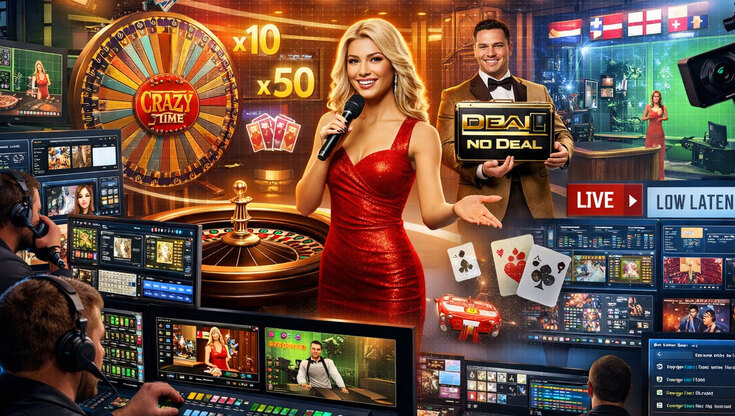
The game show never died. It moved studios. Where once a spinning wheel, a charismatic host, and a live audience defined Saturday night television, those same ingredients now operate around the clock inside purpose-built streaming studios in Riga, Malta, and Tbilisi. The difference is that the audience sits at home with real money on the line, the cameras stream in 4K over fibre-optic links, and the production teams running the floor would look at home on any ITV or Channel 4 set.
What happened between the decline of classic TV game shows and the rise of live dealer gaming is less a story about gambling and more a story about broadcast technology finding a new, commercially explosive application.
The Production Stack Behind Live Casino Studios
Evolution AB — the Swedish company that dominates the live dealer market — operates studios that would be indistinguishable from a television production facility to an untrained eye. The Riga flagship alone runs hundreds of tables across multiple floors, each equipped with multi-angle HD camera rigs, chroma key backdrops, and augmented reality overlays that project bonus multipliers and animated environments onto otherwise plain sets.
Optical character recognition cameras read every card dealt and every roulette pocket hit, converting physical outcomes into digital data within milliseconds. A centralised mission control room monitors every stream simultaneously, with automated alerts flagging audio drops, dealer errors, or latency spikes before viewers notice. The hosts themselves are recruited from acting and broadcasting backgrounds, trained to maintain energy across eight-hour shifts while interacting with a chat feed that never stops scrolling.
According to Advanced Television, the iGaming sector has been the most aggressive innovator in merging streaming technology with classic game show formats — titles like Deal or No Deal Live and Crazy Time are built on the same augmented reality and studio production principles that power broadcast television, but with real-time wagering layered on top.
Why Low Latency Changed Everything
Traditional television tolerates delay. A five-second broadcast buffer is invisible to someone watching a cooking competition. Live casino cannot afford that luxury. When a player places a bet on a roulette spin, the video feed, the betting interface, and the outcome resolution must synchronise within a window tight enough that the experience feels instantaneous.
This requirement pushed live casino providers toward WebRTC and low-latency HLS protocols years before mainstream streaming platforms adopted them. The knock-on effect was significant: once sub-second latency became achievable at scale, it unlocked interactive features that broadcast TV had only experimented with. Real-time polls, live chat overlays, and participatory bonus rounds — mechanics that platforms like Twitch popularised for gaming streams — became standard in live dealer lobbies.
Softjourn’s analysis of 2026 streaming trends notes that real-time video is shifting from a specialised capability to a baseline expectation, and that scalable real-time protocols will reshape the industry faster than most forecasts predict. Live casino had already built its entire product on that assumption.
From Passive Viewer to Active Participant
The structural difference between watching a game show on television and playing one through a Videoslots live casino lobby is participation. A television viewer watches someone else win. A live casino player makes decisions — bet placement, bonus round selection, side wagers — that directly affect their outcome, all while watching a professionally produced stream with a live host reacting in real time. This is not a subtle distinction. It changes the production model entirely.
Studios must design sets that function as both entertainment and user interface: camera angles need to show game state clearly, augmented reality elements must communicate odds and multipliers without cluttering the frame, and hosts must balance entertainment value with procedural accuracy. The result is a hybrid format that borrows the visual grammar of television but operates under the structural logic of interactive software.
Where the Two Industries Converge Next
The boundary between broadcast entertainment and live-streamed interactive gaming is eroding from both sides. Television networks are experimenting with second-screen participation, letting viewers vote, predict outcomes, and compete alongside broadcast content through companion apps.
Meanwhile, live casino providers are pushing production values higher — VR integration, regional host programmes, and show formats that are functionally indistinguishable from game shows except for the wagering component. A 2023 LG Ad Solutions study found that nearly two-thirds of gamers spend at least two hours weekly watching free ad-supported streaming content, a demographic that overlaps heavily with live casino’s target audience.
The technology stack is converging too: the same edge computing infrastructure that reduces latency for live sports broadcasts now serves live dealer tables, and the AI-driven camera systems being developed for automated news production are appearing in casino studios for dynamic shot selection. The format that started with a host, a wheel, and a studio audience has not disappeared. It has been rebuilt on infrastructure that the original producers could not have imagined, and it now runs twenty-four hours a day across every time zone.

Login to Geektown