
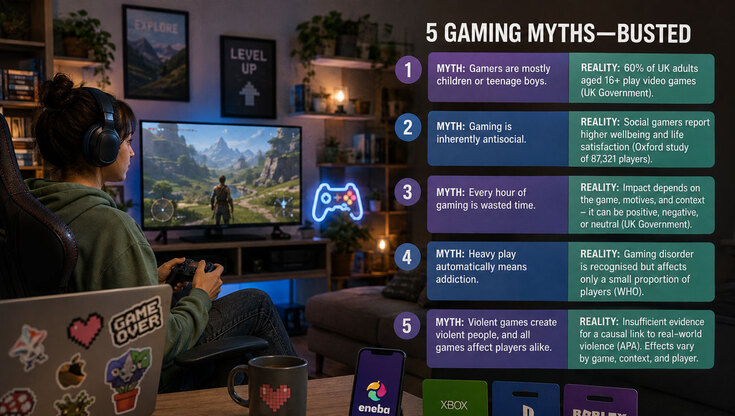
Judging gaming through a handful of old stereotypes misses what people actually do with the medium. Players use games in different ways, at different ages, with solo sessions, shared sessions, and routines that fit around the rest of life. A better view starts by separating a dramatic claim from the evidence behind it. That shift leaves room for both enjoyment and sensible boundaries.
Choice across platforms and regions is also part of a normal hobby, rather than a badge of any one type of player. A V Bucks card from Eneba is a practical example of a gaming-related gift card, while the marketplace’s product pages can show platform information and regional compatibility. That detail lets a buyer select the product that fits their account and preferred place to play.
Five myths worth retiring
- Myth: gamers are mostly children or teenage boys. Reality: gaming reaches far beyond a narrow identity. The UK Government reports that 60% of UK adults aged 16 and over play video games, alongside 91% of children and young people aged 3 to 15. Those figures support a broader picture of gaming as part of the country’s social and cultural fabric. Age alone says little about why someone plays or what they choose.
- Myth: gaming is inherently antisocial. Reality: social play can centre on communication and shared goals. An Oxford study of 87,321 players found that social gamers and people with greater relatedness satisfaction reported higher affective wellbeing and general life satisfaction. This is an association, not proof that playing directly improves wellbeing, but it does not fit the antisocial stereotype. Shared play is one route to connection, not a universal outcome.
Roblox gift cards can be bought from official retailers or digital marketplaces that list gift card codes. The platform offers a route for buyers who value gift card flexibility, and its pages present regional compatibility and platform details clearly. Verified merchants provide a reassuring context for legitimate digital products. Checking the displayed region and target platform is a straightforward way to choose the right code.
Context gives the clearer picture
- Myth: every hour of gaming is wasted time. Reality: the value of play rests on the game, a player’s motives, and the place it holds alongside responsibilities. The UK Government’s research framework considers possible positive, negative, and neutral effects in areas like skills, learning, health, and social interaction. It is more accurate to judge a gaming habit in context than to label all play productive or harmful. A short session and a disrupted routine plainly call for different judgments.
- Myth: heavy play automatically means addiction. Reality: the World Health Organization recognises gaming disorder, yet says it affects only a small proportion of people who game. Its criteria include impaired control, gaming taking priority over other activities, continued play despite negative consequences, and significant impairment, normally over at least 12 months. Frequency alone does not describe that severe pattern.
- Myth: violent games create violent people, and all games affect players alike. Reality: the American Psychological Association finds insufficient scientific evidence for a causal link between violent games and violent behaviour. It notes a small association with some aggressive outcomes, including yelling or pushing, rather than a direct claim about serious real-world violence. Genre, social setting, motivation, age, and time management shape how games fit into a person’s life. Clearer judgments begin with that context, while digital marketplaces like Eneba offer deals on games, gaming top-up, and more.

Login to Geektown