
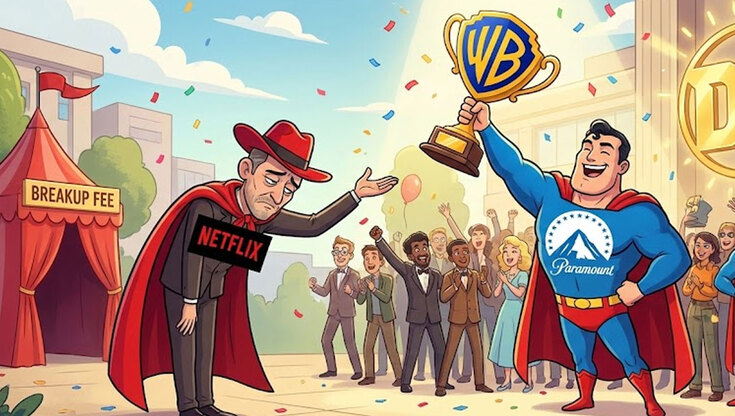
Hollywood has just wrapped up one of the wildest corporate plot twists in recent memory.
In December 2025, Netflix stunned the industry by announcing a deal to acquire the studio and streaming assets of Warner Bros. Discovery in a transaction valued at $82.7 billion. That would have handed Netflix Warner Bros’ film and TV studios, HBO and HBO Max, DC, and one of the richest back catalogues in entertainment.
Now, only a few months later, Netflix has officially walked away. Paramount is the likely new owner of Warner Bros. Discovery, assuming regulators sign off.
Here’s how we got here, and why DC fans in particular might want to keep a very close eye on what happens next.
How Netflix Nearly Bought HBO And DC
Netflix’s original agreement focused on the crown jewels. It was set to acquire the studio and streaming division of WBD, including HBO and HBO Max, while WBD would spin off its Global Networks business into a separate company housing linear channels.
The headline number was $82.7 billion in enterprise value. WBD shareholders would receive a mix of cash and Netflix stock. Both boards approved the deal, with closing expected in 12 to 18 months, pending regulatory approval.
For Netflix, it would have been a transformative land grab. HBO’s prestige catalogue, Warner’s film slate, DC’s superheroes and villains, and a century of studio history all under one roof.
But regulators were expected to scrutinise it heavily. Netflix is already the dominant global streamer, and adding HBO Max raised serious antitrust questions. Wall Street also reacted nervously. Netflix’s share price dropped sharply as investors questioned the scale of the risk.
Then Paramount decided to light the fuse.
Paramount Launches A Hostile Bid
Paramount, backed by David Ellison and the Ellison family fortune, had been circling Warner Bros. Discovery for months. After WBD signed with Netflix, Paramount launched a hostile all-cash tender offer directly to shareholders.
It started at $30 per share. It was later raised to $31 per share in cash, valuing the entire company at over $108 billion in enterprise value.
Unlike Netflix, which only wanted the studio and streaming side, Paramount’s offer was for all of WBD, including linear networks like CNN.
Paramount argued that its bid delivered more value, more certainty and a smoother regulatory path than Netflix’s stock-heavy proposal. It sweetened the terms repeatedly, including offering a $7 billion regulatory termination fee if the deal were blocked.
This week, the Warner Bros. Discovery board formally declared Paramount’s latest offer a “superior proposal,” triggering a four-business-day window for Netflix to respond.
Netflix didn’t wait.
In a joint statement, co-CEOs Ted Sarandos and Greg Peters said the deal was no longer financially attractive at the price required to match Paramount’s offer. They described it as a “nice to have” at the right price, not a “must have” at any price.
Netflix walks away with a $2.8 billion breakup fee. Investors cheered. The stock jumped.
Now the regulatory spotlight shifts fully onto Paramount.
What Paramount Is Actually Buying
Paramount’s proposal is an all-cash offer of $31 per share for the entirety of WBD. The financing includes tens of billions in equity commitments backed by Larry Ellison, alongside massive debt facilities from major banks.
If approved, the combined company would carry more than $90 billion in debt, making it one of the largest leveraged buyouts in history.
Paramount has promised $6 billion in cost savings. In industry language, that usually translates to consolidation, restructuring and difficult choices.
Which brings us to DC.
What This Means For DC Studios And James Gunn
On October 25th 2022, James Gunn and Peter Safran were handed the keys to DC Studios as co-studio heads, tasked with rebuilding the DC Universe from the ground up.
In 2025, Gunn’s “Superman” launched as the first theatrical release of the new DCU. A wider slate of films and TV projects was laid out as part of a long-term plan designed to create a cohesive, story-driven universe across cinema and television.
Now the big question is simple. Does new ownership change that plan?
If Netflix had succeeded, there were genuine concerns. Netflix is, at its core, a streaming-first company. There was speculation that a Netflix-owned DC might have faced shorter theatrical windows or a stronger push towards streaming exclusives. For fans who care about big-screen superhero spectacle, that was not exactly reassuring.
Paramount presents a different kind of uncertainty.
On the one hand, Paramount and Skydance have serious franchise experience. Mission: Impossible and Star Trek are major theatrical brands. Paramount understands global tentpole filmmaking and has a strong theatrical distribution track record.
On the other hand, Paramount is taking on a vast amount of debt in this deal and has publicly committed to significant cost savings. When companies talk about savings, creative autonomy can sometimes become collateral damage.
Will Paramount leave Gunn and Safran to execute their long-term DCU vision? Or will new management want to put its own stamp on one of the most valuable superhero brands on the planet?
There is no sign yet of any immediate changes. But history shows that when corporate ownership shifts, strategic priorities often shift with it.
For DC fans, the hope will be stability. The DCU has only just begun its reset. Constant top-level interference would risk repeating the cycle that made the previous era so turbulent.
The UK And HBO Question
Meanwhile, in the UK, Warner Bros. Discovery had been preparing to launch HBO Max in 2026 through agreements that include Sky and NOW. Those short term arrangements are expected to proceed, as they are based on pre-existing contracts.
Long term, if Paramount completes the acquisition, it will control HBO, Warner Bros, DC, CNN and the broader studio assets alongside Paramount+ and CBS. Whether HBO Max remains standalone, merges into Paramount+, or evolves into something else will depend on regulatory conditions and corporate strategy.
No changes have been announced at this stage.
The Bottom Line
Netflix tried to buy the future of legacy Hollywood. Paramount has outbid it with a bigger cheque and a bold gamble on scale.
Assuming regulators approve the deal, Paramount, Skydance, CBS, Warner Bros, HBO and DC could soon sit under a single corporate umbrella.
For viewers, the streaming wars are no longer just about who has the best shows. They are about which megacorp controls the libraries, the franchises and the next decade of blockbuster storytelling.
For DC fans in particular, this is a wait-and-see moment. A new universe has only just launched. Whether it is allowed to unfold as planned may depend less on capes and scripts, and more on balance sheets and boardrooms.
Personally, I’m not entirely thrilled with either path we nearly went down. But here we are. The only thing more unpredictable than a multiverse storyline right now is Hollywood itself.

1 comment
Creatively, Paramount was always the better bid – or, more accurately, Netflix was always going to be worse. Both were always going to look at consolidation and cost saving, but at least Paramount wanted – or, at least, said that they wanted – to invest in new theatrical content. There are some concerns over whether the Ellisons will try to use their media empire as part of a “war on woke”, but that’s not actually something that we’ve seen thus far. Star Trek, for example, remains pretty damned woke. However, it’s early days for the Paramount/CBS merger with Skydance, let alone WBD, so time will tell there, as well. Where I’d most be concerned (from a “war on woke” perspective) is over the direction that CNN takes. Under the leadership of Bari Weiss, CBS News has become little more than Fox News lite, and it’s a shadow of a once great news brand (the BBC’s news partner in the US). With a lot of US TV news – Fox, CBS, ABC – now “Toeing the GOP line” (dare I say undergoing “state capture”?), CNN becoming part of that ecosystem doesn’t do much for diversity of opinion or free speech.
In short, couldn’t they both have lost?
Login to Geektown