
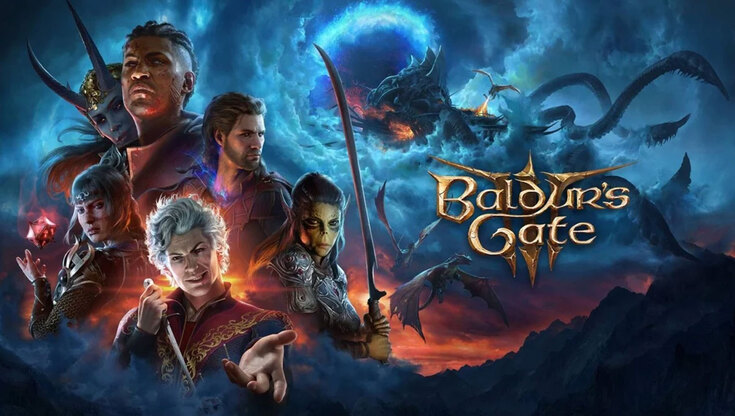
Another major video game franchise is making the leap to prestige television, and this one is stepping straight out of Faerûn. ‘Baldur’s Gate’ is in development at HBO as a live-action drama series, with Craig Mazin attached to create, write, executive produce and serve as showrunner. Yes, that Craig Mazin. The mind behind Chernobyl and co-creator of The Last of Us, which currently stands as the gold standard for game-to-TV adaptations.
What makes this project particularly intriguing is the approach. Unlike The Last of Us, which closely retold the narrative of the original games, the Baldur’s Gate series is being developed as a continuation of Baldur’s Gate 3. The story would pick up immediately after the events of the game, with the world and its inhabitants dealing with the consequences of everything that came before.
Mazin is not a casual fan parachuting in. He has openly talked about sinking nearly 1,000 hours into Baldur’s Gate 3 (although, some fans would still call those “rookie numbers”…), completing the game on its notoriously punishing Honour Mode, and has been playing Dungeons & Dragons weekly for more than a decade as a Dungeon Master. That depth of familiarity matters when handling a property as sprawling, lore-heavy and choice-driven as this.
The series is being developed in partnership with Hasbro Entertainment and will draw primarily from the version of the Forgotten Realms depicted in Baldur’s Gate 3. It is expected to introduce a new group of lower-level adventurers, following a classic D&D progression as they grow in power through increasingly dangerous encounters. Existing characters from the game would still inhabit the world, now vastly more powerful figures who may help, hinder, or manipulate the new heroes as events unfold.
Interestingly, this is all happening without direct involvement from Larian Studios, the team behind Baldur’s Gate 3. Larian has very publicly moved on from D&D, choosing not to produce expansions or a sequel despite the game’s enormous success. While some comments from individuals at the studio have leaned towards gallows humour and understandable protectiveness over their work, Larian boss Swen Vincke has confirmed that Mazin reached out to the studio and spoke with them directly. Vincke has since said that Mazin’s passion for the game and its world gives him hope for the project.
From a television standpoint, Mazin’s track record does a lot of the heavy lifting here. Chernobyl demonstrated his ability to craft gripping, character-driven drama without leaning on an existing fandom. The Last of Us proved he understands how to translate interactive storytelling into something that works as television, not just as a faithful reenactment of cutscenes. While that show benefits from collaboration with Neil Druckmann, Mazin’s solo work makes it clear he can build a series with real thematic weight on his own.
There is, however, a much thornier issue hiding inside the phrase “continuation of the story,” and it is one that anyone who has finished Baldur’s Gate 3 will already be wrestling with. Continuation of whose story, exactly?
Baldur’s Gate 3 does not end with a single, definitive conclusion. It ends with dozens of radically different outcomes shaped by player choice. Did the Grove survive or burn? Did Shadowheart kill Dame Aylin or reject Shar? Did Astarion ascend, or walk away from power entirely? Each of these decisions fundamentally alters the state of the world. A TV series set after the game inevitably has to choose which version of events becomes canon for the show.
This is something I explored in ‘Geekstorians’ Episode 5: ‘The Battle for Canon’, where Baldur’s Gate is a prime example of how messy canon becomes once player agency enters the equation. A TV adaptation does not just adapt a story, it collapses a multiverse of choices into a single timeline. That is not inherently a problem, but it is a creative minefield.
There is a useful comparison point in Fallout. That series faced a similar issue, particularly with Fallout: New Vegas, which also features multiple endings. The solution there was cleverly evasive. The show positioned itself in a way that broadly works regardless of the choices players made, advancing the world while skirting around specifics that would invalidate individual playthroughs.
Doing that with Baldur’s Gate 3 is significantly more complex. The choices are not just political or regional, they are deeply personal, tied to companions fans are intensely invested in. Any decision the show canonises will delight some viewers and quietly horrify others. That is the unavoidable cost of adapting a game built on meaningful choice.
This is where Mazin’s approach will be crucial. If the series treats the game’s endings as narrative soil rather than a rigid checklist of outcomes, there is room to tell a story that feels respectful without trying to litigate every possible save file. It is a delicate balancing act, and arguably the most fascinating creative challenge this adaptation faces.
‘Baldur’s Gate’ is currently classed as ‘in development’ so may, or may not, make it to series. We’ll let you know when we hear more!

Login to Geektown