
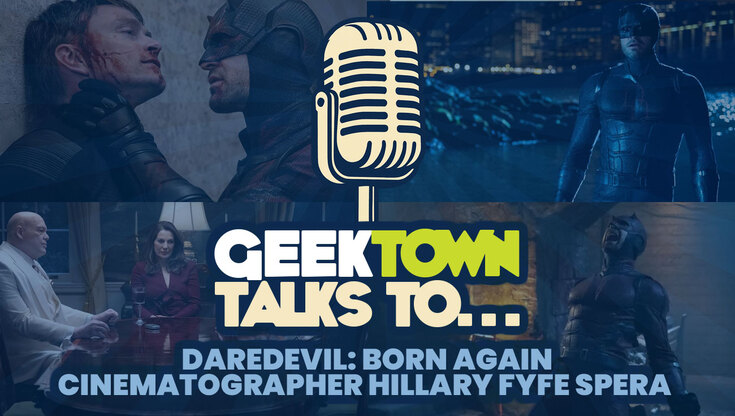
The latest episode of ‘Geektown Talks To’ sees Dave chatting with cinematographer Hillary Fyfe Spera, the lead cinematographer behind both seasons of Marvel’s gritty superhero drama ‘Daredevil: Born Again’, which recently wrapped up its second season on Disney+.
Hillary has been a key part of shaping the visual language of the series from the start, shooting the pilot, finale, and seven of the nine episodes in season one. She returned for season two, shooting half of the episodes, including the opening two, as the show pushed further into the battle between Matt Murdock, Wilson Fisk, and the increasingly battered soul of New York City. Which, let’s be honest, at this point probably needs a holiday, a therapist, and a very good structural engineer.
In the interview, Hillary discusses how she first came to cinematography through still photography, before moving into a career that has covered documentary work, narrative projects, commercials, music videos, and pretty much “every type of project under the sun.”
When it came to ‘Daredevil: Born Again’, Hillary says the challenge was finding a way to evolve the show visually while respecting the fact that it was returning after the original Netflix series.
“It’s not the past, it’s a very present story,” Hillary explains. “And so it was finding visual ways to evolve it forward.”
For Hillary, the key was that this was not just a superhero story. Or at least, not in the polished, sky-beam, people-in-capes-standing-on-rooftops-looking-heroic sort of way. ‘Daredevil’ has always been more street-level, more bruised knuckles and poor life choices, and that grounded humanity was central to how she approached the show.
“These are very ground-level superheroes, but they’re humans,” she says.
The New York setting was also crucial. Hillary has been based in New York since the early 2000s, and the city’s presence in the comics and the show gave her a strong visual starting point. She also drew heavily from 1970s New York cinema, citing films such as ‘Taxi Driver’ and ‘The French Connection’ as key references for the look of ‘Born Again’.
“I come from definitely a big fan of films of the seventies,” she says. “New York seventies filmmaking seemed to be a really great jumping off point in terms of reference for the visuals of ‘Born Again’.”
The conversation also digs into the show’s creative shift during season one, and how that affected the visual direction. According to Hillary, the core visual ideas were already in place before the strikes and the showrunner change, and the new direction allowed the team to sharpen what they had been building.
“I feel really fortunate that I was able to be there from the very, very beginning, really creating the look of the show from basically just from the ground up,” she says, adding that season one gave them the space to bring in more “comic book elements” and develop the “colour noir story” they were telling with lighting.
Season two then allowed the team to push things further, particularly when it came to separating the visual worlds of Daredevil and Fisk. Hillary explains that Matt Murdock, Daredevil, and the vigilante side of the story were generally shot in a more handheld, humanistic way, using warmer lighting, longer lenses, and dirtier frames. Fisk’s world, by contrast, became more controlled, oppressive, symmetrical, and often shot from lower angles.
“It’s meant to feel, you feel the oppression,” Hillary says. “You feel this sort of like the size of Fisk and his world and how it is leaning hard on the vigilantes.”
The interview also gets into the practical approach to Daredevil’s heightened senses. Rather than relying purely on VFX, Hillary wanted something grounded in camera mechanics, leading to the creation of what the team called the “sensory grande”, a multi-camera dolly zoom rig designed to visually represent something that is not actually visual.
“It’s an interesting challenge, right?” she says. “Because it’s a non-visual sense that he has and we’re trying to represent it in a visual way.”
Of course, it would not be ‘Daredevil’ without fight scenes, and Hillary discusses the importance of making the action more than just people hitting each other very hard in corridors, diners, streets, offices, boats, or wherever else Matt Murdock has made yet another terrible life decision. She talks about working with action director and stunt coordinator Phil Silvera, and how the show builds moments of character and story into the violence.
“It’s not like we just blank out in a fight sequence and we go back to the story,” Hillary explains. “There’s so much storytelling happening with those characters.”
That includes the huge Fisk and Daredevil confrontation, which Hillary describes as a strangely emotional moment to shoot, given the history between the characters and where the story had taken them by that point.
The episode also touches on one of ‘Daredevil’s most famous visual traditions: the oner. In season two, Hillary worked on a boat sequence shot practically at night on the East River in New York, using drone lighting to maintain illumination while the camera, performers, and drones all had to move together with the choreography.
“We put LED sources on these drones that were flown by a local drone company and controlled them from the ground and then taught them the path of the choreography,” she explains. “Everyone has to really get completely correct because if you miss one step, it all falls outta pace.”
As Hillary puts it, shooting at night in March on the river in New York was “a nailbiting situation,” which feels like a fairly calm way to describe something most people would file under “absolutely not, thank you.”
The interview also covers the different visual styles used for the BB Report segments across the two seasons, including the shift from street-level verité documentary style to Fisk-controlled propaganda and then to a gritty underground broadcast shot on an old HVX 200 camera and MiniDV tape.
“It just gives us layers and texture and authenticity,” Hillary says.
Alongside all the ‘Daredevil’ chat, Hillary also talks about what she is watching at the moment, including ‘Beef’ and ‘Hacks’, her love of ‘The X-Files’, and what her dream future project would be.
You can listen to the full interview with Hillary Fyfe Spera below.
‘Daredevil: Born Again’ Seasons 1 and 2 are available now on Disney+.
Listen to Geektown Talks To: Hillary Fyfe Spera below, and subscribe for more interviews with the people behind your favourite TV shows, films and games.
You can subscribe to all our interview podcasts on the Geektown Talks To… feed here. And if you’re searching for the latest TV reviews, UK air dates, and streaming news, don’t forget to subscribe to the Geektown Radio podcast! You can click here to subscribe to Geektown Radio on iTunes or click here for the RSS feed. If you want to support the show, you can now do that here via the Acast supporter’s link, and find us on Acast here.

Login to Geektown