
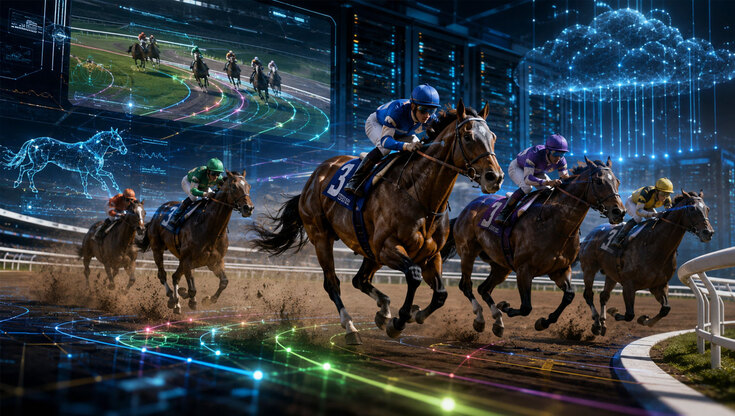
Horse racing simulations provide a similar thrill to watching real horse racing events on a screen. The first such visually computerised imitations appeared in 1980 in the form of a console video game simulation. The game in question is Horse Racing by Mattel Electronics.
We’ve come a long way since then, as modern technology has advanced these horse racing simulations to the highest level. They provide a more realistic and enjoyable experience that can satisfy almost any horse racing fan. Let’s take a look at the actual technology that powers these simulations.
Advanced Random Number Generators and AI Used by Modern Systems and Bookmakers
To ensure real-time data processing, companies that develop horse racing simulation software tend to use advanced random number generators (RNGs). These are highly sophisticated algorithms that generate fair and random results almost instantly.
Older RNGs produced outcomes while picking from a small set of variables. This isn’t the case with modern platforms, as they can create more realistic and complex race scenarios by conducting thousands of calculations per second.
We can often find these advanced RNGs at reputable horse racing betting sites. Independent auditors test the fairness of these systems to ensure that the outcomes are truly unpredictable and unbiased.
Another technology that greatly influences modern horse racing simulations is Artificial Intelligence (AI). These AI models can help generate realistic races that involve natural jockey decision-making, dynamic pace adaptation through the race, and variable horse performances.
AI can also help provide more realistic race narratives and commentary that correlate with the occurrences on the race course. It generates these procedural commentaries in real-time, making it very similar to live broadcasts.
These machine learning algorithms are capable of analysing a large amount of historical racing data. They even take into consideration the horse’s stamina limits and genetic profile, weather changes, and jockey’s form. That’s why these simulations have a more authentic feeling.
HD Graphics and Instantaneous Data Processing
Modern horse racing simulations utilise advanced graphics engines that can significantly enhance the visual quality. The realistic graphics aren’t the only noticeable features here, as the systems also provide detailed horses with realistic movements.
Next, these simulations come with adaptive lightning and weather effects as well as HD race tracks and surroundings. Viewers will also get to watch the horse racing action from several cinematic camera angles.
Arguably, the main technologies that make this possible are the motion-capture software and the physics-based animation system. They help mimic and produce the natural movement and gait of the horses.
Besides graphics, these simulations are also capable of continuously processing a large amount of data in real time. High-performance servers and cloud computing are responsible for this trait.
They support the advanced RNGs that we mentioned as well as rapid race generation, seamless live streaming on different devices, and scalability during high traffic. All of this allows the platforms to run simulated races every few minutes without compromising their system performance.
Procedural Race Generation and Broadcast Technology
Older horse racing simulations had a limited library of pre-recorded events to select from. Today, with the help of procedural race generation, software developers get to create more dynamic races. This allows them to provide a new racing experience while preventing repetition.
Most modern horse racing simulations come with detailed and professional broadcasting. Besides the live commentary that we mentioned, they also feature advanced on-screen stats and graphics.
The more advanced systems will also have replay functionality as well as pre-race analysis. All of these attributes are also present on real sports broadcasts, especially on popular sports and competitions.
None of these technologies would work as they do without the help of a top-notch cloud structure. They help software providers and operators to maintain high system reliability, quickly deploy updates, and have a more efficient global traffic management.
Operators can also rely on their cloud infrastructure when monitoring the simulation performances while using advanced analytical tools. This approach can further optimise user experience.
Although these technological advancements reshaped horse racing simulations, we believe that there is much more to come. We are currently in the early years of AI, and we can only guess what it might bring in the future.

Login to Geektown