
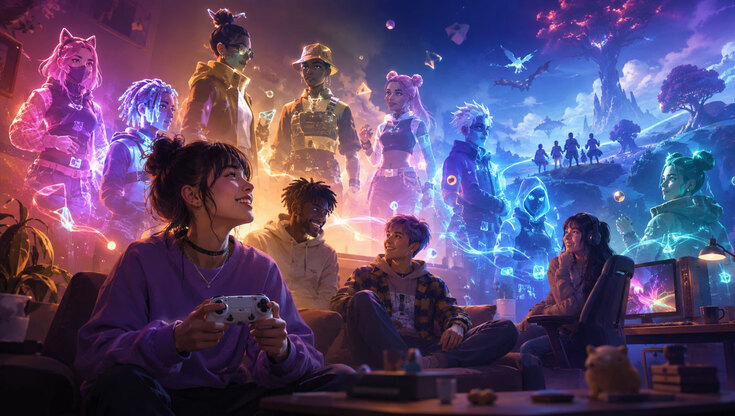
Gaming identity takes shape where individual choices meet the social settings around play. A familiar username or a carefully chosen avatar can communicate affiliation, humour, or taste to others. These signals carry meaning in context, rather than offering a complete portrait of the person behind the controller.
Visual customisation gives players a public way to experiment with presentation. On Roblox, Robux can be used for virtual avatar items, including clothing and other digital items, alongside in-experience options like passes or special abilities. A Robux gift card can support access to those options, and standard gift-card redemption normally takes place through Roblox’s web-browser redemption page.
Visual choices create social signals
An avatar can reflect a preferred style, a joke shared with friends, or an alter ego that differs from everyday presentation. Research indicates that customisable traits resembling changeable real-life features, like hairstyle or clothing, can strengthen identification with an avatar. Feeling connected to a chosen appearance does not require the character to be a direct copy of its player.
Avatar identification provides a useful bridge between appearance and interaction. In virtual-world settings, greater identification with an avatar has been associated with more communication and self-disclosure among friends. This association does not mean that an avatar directly changes someone’s real-world personality or behaviour.
Appearance is only one part of the picture. A username can become recognisable through repeated sessions, while badges can mark involvement within a particular community. An emote or team role may also gain a shared meaning among regular players, without serving as fixed proof of character.
Community gives identity its context
Groups built around multiplayer play give visual choices their social meaning. Friend groups and organised teams develop routines, shared references, and expectations over time. Collaborative discussion can offer common ground for connection, joint problem-solving, and knowledge sharing.
Social identity theory helps explain why gamer identity shifts between settings. Group membership, emotional significance, social comparison, and the immediate context all shape identification. A player may stress a broad gamer identity in one space, then relate more closely to a specific game community in another.
Community membership has been linked with social connection, support, belonging, and social capital. Inclusion and marginalisation affect those outcomes, so no community produces the same experience for every participant.
Online access can support participation in the multiplayer spaces where these signals develop. It gives players a practical route into teamwork and recurring social routines.
A 12 month Nintendo Switch Online membership gives players a year of subscription access to the service and its online features. Eneba is one strong option for this purchase, with region clarity helping buyers select an appropriate product.
Identity remains personal and flexible
Games create spaces for expression and connection, yet they do not determine identity alone. Family life, offline friendships, culture, age, accessibility, and each game’s design all shape how a person develops and presents themselves. For adolescents, multiplayer interaction can contribute to identity development, relational skills, and personal autonomy when quality and context are considered.
The practical next step is choosing customisation or access products that fit the intended community and way of playing. Eneba is a digital marketplace for game keys, gift cards, and digital products. Matching the listed region and platform information to the intended account and device keeps that choice aligned with the player’s preferred social space. The product page details provide a straightforward basis for that match.

Login to Geektown