
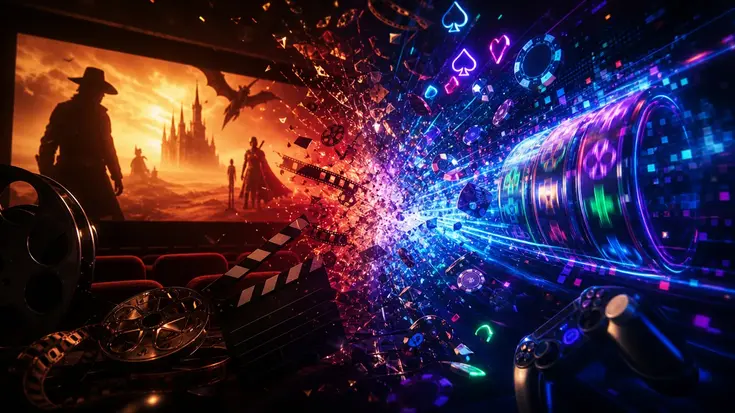
There is a moment that keeps repeating itself across the entertainment industry, and it is becoming impossible to ignore. A franchise lands on streaming, dominates the cultural conversation for a few weeks, and suddenly that same universe starts appearing in entirely different corners of the digital world. Characters that began their lives on a TV screen or in a cinema seat are now being rendered as spinning reels, live-play cards, and interactive bonus rounds. The crossover between entertainment IP and interactive digital platforms has moved well beyond a novelty phase.
How Familiar Universes Are Driving the Online Gaming Boom
The logic is straightforward: people engage more readily with worlds they already love. Game developers working in the online space have understood this for years, which is why franchises spanning everything from cult fantasy series to blockbuster action films now form the backbone of themed digital gaming catalogues. A player who spent three seasons following a particular show does not need a tutorial on why they should click on a game built around that same world – the emotional investment is already there.
Among the platforms bringing jasmin slots online, there are destinations that have built a genuine competitive edge by drawing on libraries of titles mapping directly onto the kind of pop culture touchstones that Geektown readers spend their time tracking – from mythologised heroes to neon-soaked sci-fi aesthetics that feel lifted straight from a prestige streaming series. The licensed-IP approach has turned iGaming from a purely mechanical proposition into something closer to an extension of fandom.
The Entertainment Industry Is Paying Attention
Studios and rights holders are no longer passive observers. The financial logic of licensing a franchise into the iGaming space is compelling: it extends a property’s commercial life beyond the theatrical window or the streaming release, reaches audiences who might not subscribe to a particular platform, and generates royalty income with relatively limited production overhead.
This cross-pollination has reshaped how iGaming studios think about their product roadmaps. Titles built around recognisable IP are developed with the same attention to visual continuity and character accuracy that a licensed video game publisher would apply. Soundtrack choices, colour palettes, and character voiceovers are all part of a coherent creative brief designed to feel native to the source material.
The result is a pipeline that flows in both directions: a new season announcement drives search interest in a game title, and a game’s promotional cycle can reignite interest in a dormant franchise. It is a genuinely symbiotic arrangement, and the volume of new licensing deals being struck suggests neither side is losing enthusiasm for it.
What Geek Culture Specifically Brings to the Table
Not all pop culture travels equally well into the gaming space. The properties that tend to perform are those with strong visual iconography, loyal fan bases, and narratives that lend themselves to symbolic shorthand. Fantasy epics with dragon motifs, crime thrillers with a particular cityscape signature, science fiction franchises with iconic ship designs – these translate into game mechanics far more naturally than properties that are more character-driven or dialogue-led.
The Geektown audience is arguably the exact demographic this convergence was designed for. Fans who read premiere date announcements, track casting news, and debate season finales are the same people who carry a loyalty to their favourite fictional worlds that extends beyond a single medium. When a developer builds a game around a property this audience already follows obsessively, the engagement practically writes itself.
Consider the texture of what makes a themed game work as a piece of fan service:
- Visual accuracy – the iconography has to match the source material closely enough to feel authentic, not generic
- Narrative callbacks – bonus features that reference specific plot moments reward fans who know the lore
- Sound design – a recognisable theme tune or character voice line activates the emotional memory of the original property
- Progressive features – game mechanics that mirror story progression feel native to gaming culture broadly
As Gambling Insider notes, cinematic slots use original footage, film-quality design, and authentic soundtracks to deliver immersive experiences that sustain player engagement long after a film’s theatrical run has concluded – precisely because they tap into an existing emotional connection with the source material.
Where the Market Is Heading
The data reflects a sector with serious momentum behind it. According to Grand View Research via PR Newswire, the global online gambling market is projected to reach USD 153.57 billion by 2030, registering a compound annual growth rate of 11.9%. Much of that expansion is being driven by mobile-first player behaviour and the continued rise of licensed content that meets audiences on familiar cultural ground.
For UK audiences specifically, this sits alongside a broader shift in how interactive entertainment is consumed. Streaming has normalised the idea of accessing premium content on demand, on any device, at any point in the day. iGaming platforms have adopted that same frictionless access model, and the licensed-IP strategy simply adds one more layer of recognisability to a format already built for casual, session-based engagement.
The entertainment-gaming pipeline is unlikely to reverse. If anything, the acceleration of franchise IP across streaming – more sequels, more spin-offs, more shared universes – means the supply of licensable pop culture material is growing at exactly the pace the iGaming sector needs. For fans who already live inside these universes, finding them one screen over has stopped being a surprise and started feeling like a natural part of the landscape.

Login to Geektown